

[et_pb_section fb_built=”1″ admin_label=”section” _builder_version=”4.27.4″ background_color=”rgba(0,54,130,0.07)” animation_style=”fade” animation_duration=”400ms” custom_css_free_form=”.et_pb_image_0_tb_body{|| display: none !important;||}||||.et_pb_text_3 blockquote {|| background-color: #fff;|| border-left: 5px solid #007BFF; /* Blue accent border */|| margin: 20px 0; /* Spacing around the blockquote */|| padding: 20px; /* Inner padding */|| box-shadow: 0 4px 8px rgba(0, 0, 0, 0.1); /* Subtle shadow for a modern look */|| border-radius: 10px; /* Rounded corners */||}||||.et_pb_text_3 blockquote h1 {|| font-size: 1.5rem; /* Adjust font size */|| color: #333; /* Darker font color for better contrast */|| text-align: center; /* Center-align the text */|| font-family: ‘Georgia’, serif; /* Elegant font choice */|| line-height: 1.4; /* Improve readability */|| margin: 0; /* Remove extra margin */||}||.et_pb_section.et_pb_section_0.et_section_regular {|| padding-top: 0px;||}||.et_pb_row.et_pb_row_1_tb_body {|| padding-top: 0px;||}||ow.et_pb_row_0 {|| padding-top: 0px;||}||||||/* styling tests */||||.et_pb_fullwidth_menu {|| background: #ffffff;|| box-shadow: 0 2px 10px rgba(0,0,0,0.05);||}||||.et_pb_fullwidth_menu ul li a {|| color: #000 !important;|| font-weight: 600;|| transition: color 0.3s ease;||}||||.et_pb_fullwidth_menu ul li a:hover {|| color: #0066cc !important; /* Accent hover color */||}||||.et_pb_fullwidth_menu .et_pb_menu__logo img {|| max-height: 50px;|| transition: transform 0.3s ease;||}||||.et_pb_fullwidth_menu:hover .et_pb_menu__logo img {|| transform: scale(1.03);||}||||||.et_pb_image .et_pb_image_wrap img {|| border-radius: 30px;|| box-shadow: 0 1px 5px rgba(0,0,0,0.08);|| transition: transform 0.3s ease;||}||||.et_pb_image .et_pb_image_wrap img:hover {|| transform: translateY(-3px);||}||||||/* transitions */||a, .et_pb_button, .et_pb_more_button {|| transition: color 0.3s ease, background-color 0.3s ease, transform 0.3s ease;||}||||a:hover {|| color: #0066cc;||}||||/* headings */||.et_pb_heading_container h1,||.et_pb_heading_container h2,||.et_pb_heading_container h3 {|| font-weight: 700;|| text-transform: uppercase;|| letter-spacing: 1px;|| color: #003087 !important;||}||||||||/* background enhances */||||.et_pb_section_0.et_pb_section {|| background-color: #00368212 !important;|| border-radius: 18px;|| background: #fff;|| /* border-radius: 8px; */|| box-shadow: 0 8px 24px rgba(0, 0, 0, 0.15);|| transition: box-shadow 0.3s ease;||}||||.et_pb_section_0.et_pb_section:hover {|| box-shadow: 0 10px 30px rgba(0, 0, 0, 0.2);||}||||.et_pb_row_1_tb_body{ || display: none||}||||.et_pb_row_0_tb_body {|| padding: 0 !important;||}||||.et_pb_row_2_tb_body {|| padding: 0;||}” global_colors_info=”{}”][et_pb_row column_structure=”1_2,1_2″ _builder_version=”4.27.4″ _module_preset=”default” custom_margin=”|auto|-41px|auto||” global_colors_info=”{}”][et_pb_column type=”1_2″ _builder_version=”4.27.4″ _module_preset=”default” global_colors_info=”{}”][et_pb_image src=”https://news.memphis.edu/wp-content/uploads/2024/12/Jennifer-Mandel-with-sunflowers.jpg” alt=”Woman examines sunflowers in solarium.” title_text=”Dr. Jennifer Mandel and sunflowers” align=”center” _builder_version=”4.27.4″ _module_preset=”default” custom_margin=”||||false|false” global_colors_info=”{}”][/et_pb_image][/et_pb_column][et_pb_column type=”1_2″ _builder_version=”4.27.4″ _module_preset=”default” global_colors_info=”{}”][et_pb_text _builder_version=”4.27.4″ _module_preset=”default” width=”100%” custom_margin=”|auto||auto|false|false” global_colors_info=”{}”]
I think I’ve been a biologist at heart since high school.
I loved being outside and was fascinated with nature.
At the time, I wasn’t sure how to turn that passion into a career, but it led me to study biology in college and find my true calling in plant genetics.
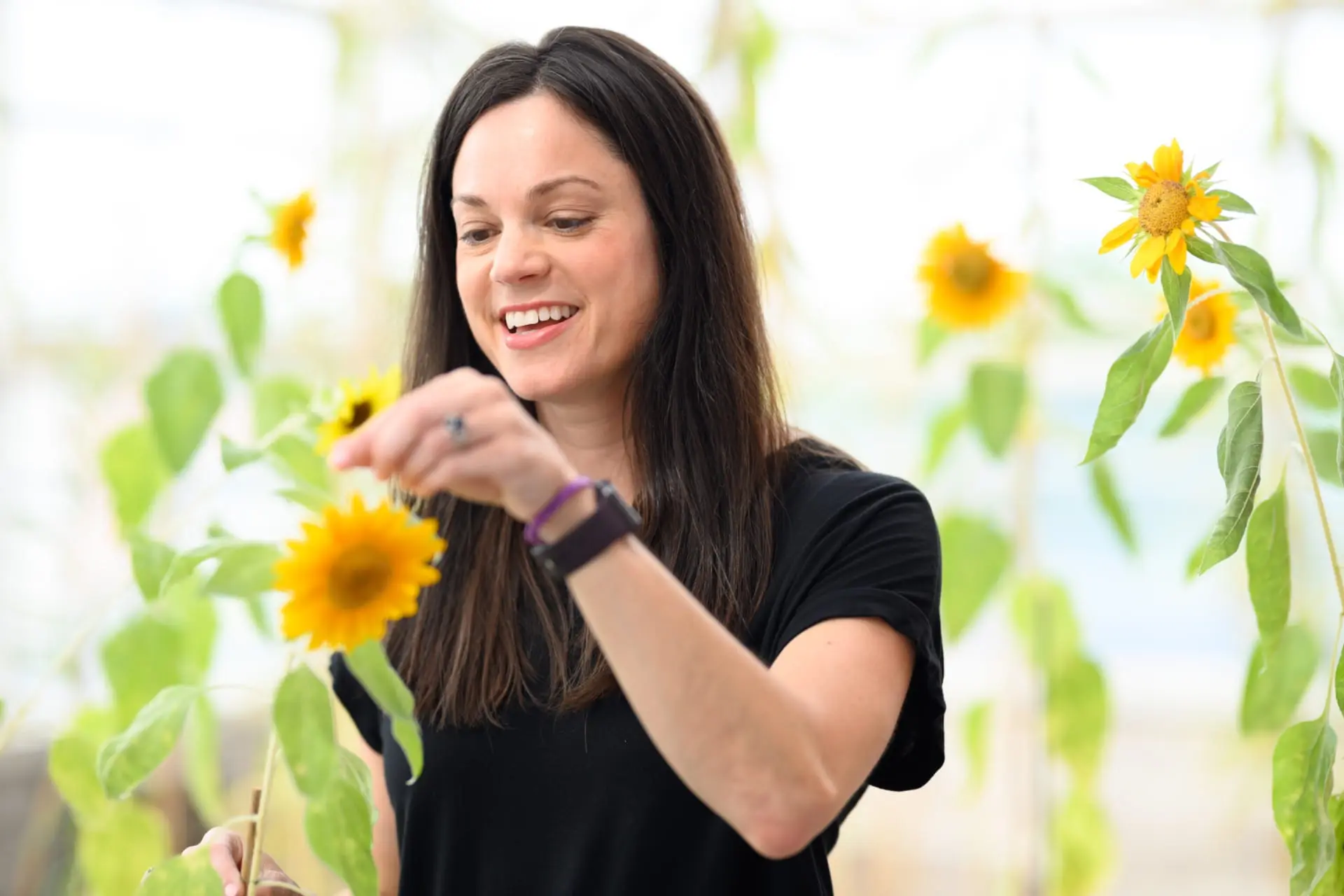
Now, as a Professor of Biology at the University of Memphis, I’ve been working with sunflowers and their relatives for about 20 years.
I often get called, “the Sunflower Professor,” and I just can’t help but be captivated by them.
[/et_pb_text][/et_pb_column][/et_pb_row][et_pb_row _builder_version=”4.27.4″ _module_preset=”default” global_colors_info=”{}”][et_pb_column type=”4_4″ _builder_version=”4.27.4″ _module_preset=”default” global_colors_info=”{}”][et_pb_text _builder_version=”4.27.4″ _module_preset=”default” global_colors_info=”{}”]
For me, it’s their biodiversity, conservation and the way they’re used in agriculture. When you combine that with their sheer beauty, it’s hard not to be drawn to these incredible plants.
Because of my research, I’m often asked, “What’s so important about sunflower genetics?”
Well, the world is changing.
People need more food, and our land is slowly disappearing.
Sunflower genetics, and DNA research in general, play a critical role in conserving biodiversity and improving crops. For example, we can use the information from plant DNA to make crops more efficient and adaptable to climate change.
[/et_pb_text][/et_pb_column][/et_pb_row][et_pb_row column_structure=”1_2,1_2″ _builder_version=”4.27.4″ _module_preset=”default” global_colors_info=”{}”][et_pb_column type=”1_2″ _builder_version=”4.27.4″ _module_preset=”default” global_colors_info=”{}”][et_pb_text _builder_version=”4.27.4″ _module_preset=”default” global_colors_info=”{}”]
Vital Research
This type of research is vital to our ability to unlock the secrets that plants hold.
I work in three primary research environments: fieldwork, labs and computational bioinformatics.
Whether it’s collecting hundred of sunflower samples across the U.S. to better understand and conserve the species or traditional lab work, each environment is unique and contributes to our overall understanding of plant genetics.
After all, we need to understand how to protect plant biodiversity today to ensure we have the resources we need in the future.
Understanding the DNA
[/et_pb_text][/et_pb_column][et_pb_column type=”1_2″ _builder_version=”4.27.4″ _module_preset=”default” global_colors_info=”{}”][et_pb_image src=”https://news.memphis.edu/wp-content/uploads/2024/12/Jennifer-Mandel-herbarium-1.png” alt=”Two students with woman pointing to plant samples.” title_text=”Jennifer Mandel herbarium 1″ _builder_version=”4.27.4″ _module_preset=”default” global_colors_info=”{}”][/et_pb_image][/et_pb_column][/et_pb_row][et_pb_row _builder_version=”4.27.4″ _module_preset=”default” min_height=”195px” custom_margin=”-34px|auto||auto||” locked=”off” global_colors_info=”{}”][et_pb_column type=”4_4″ _builder_version=”4.27.4″ _module_preset=”default” global_colors_info=”{}”][et_pb_text _builder_version=”4.27.4″ _module_preset=”default” width=”94.9%” min_height=”250.4px” custom_margin=”||-4px|||” custom_padding=”||0px|||” animation_style=”fade” animation_duration=”1400ms” global_colors_info=”{}”]
I’ve been sequencing sunflower DNA for well over a decade now, and it’s incredible what it can tell us about these plants. Sunflower genetics, in particular, can give us valuable insights into how to protect them and use their DNA to improve our crops.
In a way, the DNA of plants and organisms, in general, is like a blueprint. It can tell us about their biodiversity and the traits that might be useful for climate change or agriculture, and how we can conserve and preserve them.
The more we understand about the DNA of sunflowers and other plants, the better we can leverage that information to improve the world around us.
Not only for the sake of the plants themselves but for the resources they provide us.
[/et_pb_text][/et_pb_column][/et_pb_row][et_pb_row column_structure=”2_5,3_5″ _builder_version=”4.27.4″ _module_preset=”default” min_height=”195px” custom_margin=”-34px|auto||auto||” locked=”off” global_colors_info=”{}”][et_pb_column type=”2_5″ _builder_version=”4.27.4″ _module_preset=”default” global_colors_info=”{}”][et_pb_text _builder_version=”4.27.4″ _module_preset=”default” width=”94.9%” min_height=”250.4px” custom_margin=”||-4px|||” custom_padding=”||0px|||” animation_style=”fade” animation_duration=”1400ms” global_colors_info=”{}”]
The Launch of ACRE
We’ve launched a new institute here at the University of Memphis called ACRE, which stands for Agricultural and Conservation Research and Education.
We are very excited about the intersection of agriculture, conservation and sustainability.
Our goal is to not only serve the region better, but also train the next generation of scientists and conduct cutting-edge research.
I’m thrilled to be a part of this initiative as we continue to push the boundaries of what’s possible in agriculture and conservation.
Graduate Students
[/et_pb_text][/et_pb_column][et_pb_column type=”3_5″ _builder_version=”4.27.4″ _module_preset=”default” global_colors_info=”{}”][et_pb_image src=”https://news.memphis.edu/wp-content/uploads/2024/12/Jennifer-Mandel-herbarium-3.png” alt=”Students examine flower samples in a herbarium.” title_text=”Students in herbarium” _builder_version=”4.27.4″ _module_preset=”default” global_colors_info=”{}”][/et_pb_image][/et_pb_column][/et_pb_row][et_pb_row _builder_version=”4.27.4″ _module_preset=”default” min_height=”480.1px” custom_margin=”0px|auto||auto|false|false” custom_padding=”2px||0px|||” animation_style=”slide” animation_direction=”left” animation_duration=”1700ms” animation_intensity_slide=”5%” global_colors_info=”{}”][et_pb_column type=”4_4″ _builder_version=”4.27.4″ _module_preset=”default” global_colors_info=”{}”][et_pb_text _builder_version=”4.27.4″ _module_preset=”default” global_colors_info=”{}”]
When it comes to my research, my graduate students are indispensable, and I’d be remiss not to mention them. They help us drive our research forward and are often the ones coming up with new ideas, reading papers and really taking our research to the next step.
I couldn’t do it without them.
I’ve come a long way since I was a high school student who loved the outdoors and wanted to know how to turn that passion into a career. Today, I get to spend my days doing what I love — learning about and working with plants.
It’s not lost on me how fortunate I am to be in this position. I get to spend hours in the lab, put in the work in the field, and collaborate with some of the brightest minds in the industry.
So, the next time you’re driving down the road and see a sunflower, take a moment to appreciate its beauty and the role it plays in our world.
And, if you think of me, feel free to call me, “The Sunflower Professor.”
I’m proud to wear that title.
Research in a Minute is part of a series from the University of Memphis showcasing the innovative research being done by our faculty.
Watch Dr. Jennifer Mandel’s Research in a Minute video below.
[/et_pb_text][/et_pb_column][/et_pb_row][et_pb_row _builder_version=”4.27.4″ _module_preset=”default” global_colors_info=”{}”][et_pb_column type=”4_4″ _builder_version=”4.27.4″ _module_preset=”default” global_colors_info=”{}”][et_pb_video src=”https://youtu.be/HSbAVxubcBI” _builder_version=”4.27.4″ _module_preset=”default” global_colors_info=”{}”][/et_pb_video][/et_pb_column][/et_pb_row][/et_pb_section]