

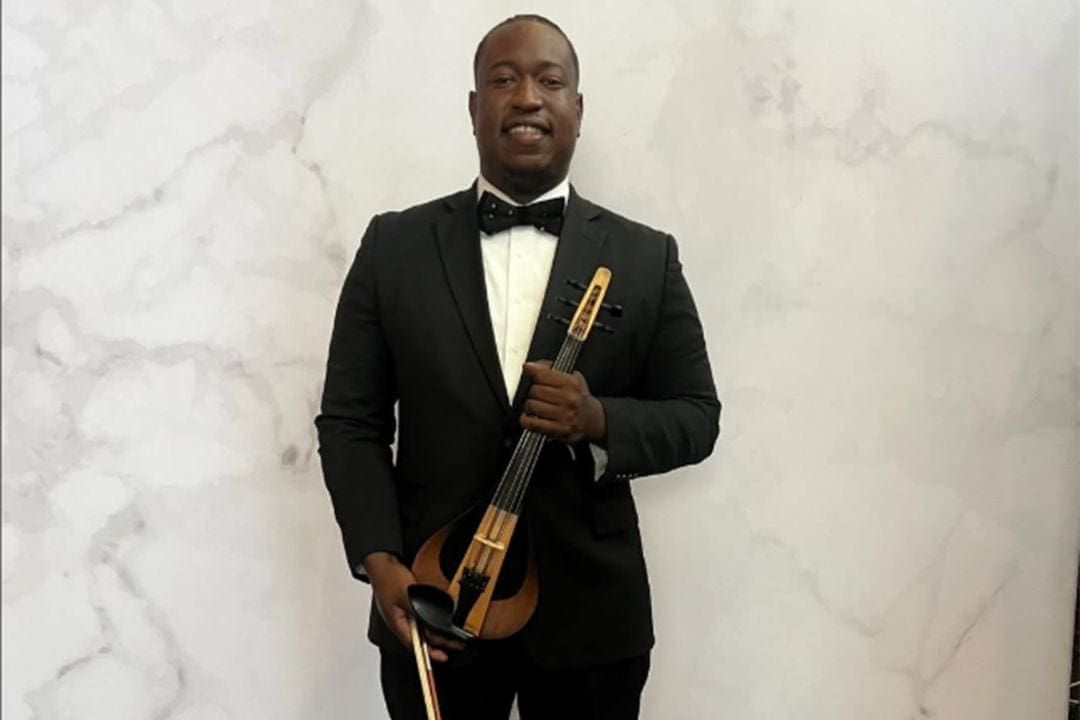
Student Spotlight | Daniel Parker
Rudi E. Scheidt School of Music
Humanity. That’s what makes music beautiful.
Not just the notes on a page or the tone from a string, but the emotions behind every melody.
In a time when AI is composing songs and digital samples can mimic any instrument, I think it’s more important than ever to remember what makes music real.
A robotic string might hit the right pitch, but it won’t carry your story.
When I play my violin, I pour my life into every note. I’ve always believed that your experiences shape how your music sounds.
Whether it’s joy, heartbreak, doubt or hope, you can hear it all in the music.
A Defining Moment in High School
I began playing the violin around the age of five, and it has been a part of my life ever since.
But one moment truly changed everything for me.
Right before my junior year of high school, I auditioned for Interlochen Arts Academy in Michigan. But here’s the twist: I had just broken my ankle playing soccer. I had surgery, couldn’t walk and had to audition from a wheelchair.
So, there I was, on stage at Belhaven University in Jackson, Miss., leg elevated, performing Bach. That was the moment I knew I wanted to pursue music professionally. Not because it was easy. Because it mattered to me so much that I showed up anyway.
Getting accepted into Interlochen was life-changing.
I went from public school in Mississippi to studying alongside some of the most talented young musicians in the country. My roommate went on to become the principal bassoonist at the Chicago Symphony Orchestra.
That level of excellence around me pushed me to grow in ways I didn’t even know were possible.
Finding My Path
Since then, my journey hasn’t been linear. I never saw myself choosing between being a performer or an educator — I wanted to do both.
And I have.
At the University of Memphis, my professors provided me with unwavering support every step of the way.
I studied with Dr. Marcin Arendt, who not only welcomed my interests in playing covers and performing at nontraditional venues but also gave me space to rehearse and workshop ideas.
I’m also incredibly grateful to Dr. Josef Hanson, whose flexibility and encouragement helped me balance teaching, performing and pursuing my PhD.
I recently finished teaching third through fifth graders at St. George’s Independent School through a fellowship with the Memphis Symphony Orchestra. There’s nothing like watching a young student light up when they realize, “Hey, I can actually do this.”
Music education is more than scales and theory. It should be fun, accessible and culturally relevant.
Growing up, if we played anything non-classical, we were reprimanded. That always stuck with me. Why limit music to one tradition?
That’s why one of my research goals is to create a lesson book that includes pop, hip hop and other genres that connect with students.
If we want kids to stay engaged, we must meet them where they are.
My Support Network
I wouldn’t be here without the people who stood by me.
First, my parents.
Violins aren’t cheap, and neither are lessons. But they always found a way to support my passion. I still have all four of my violins — from the beginner model to my electric and performance instruments.
There were times I thought I might never play again. I’ve dealt with injuries that made me question everything. But somehow, I always found my way back to the music, stronger than before. I thank God for that.
And I’m beyond thankful for the University of Memphis.
From my bachelor’s to my PhD, the support I’ve received has meant the world. My professors have seen me stretched thin by tours and projects and still encouraged me to keep going.
That kind of belief stays with you.
Looking Ahead
Eventually, I want to publish a lesson book or curriculum that reimagines what string education can look like. Something schools can use to bridge classical foundations with modern relevance.
Music should reflect the students who are learning it. Because when students see themselves in the music, they don’t just learn it. They live it.
And that’s the kind of music worth making.
One note at a time.