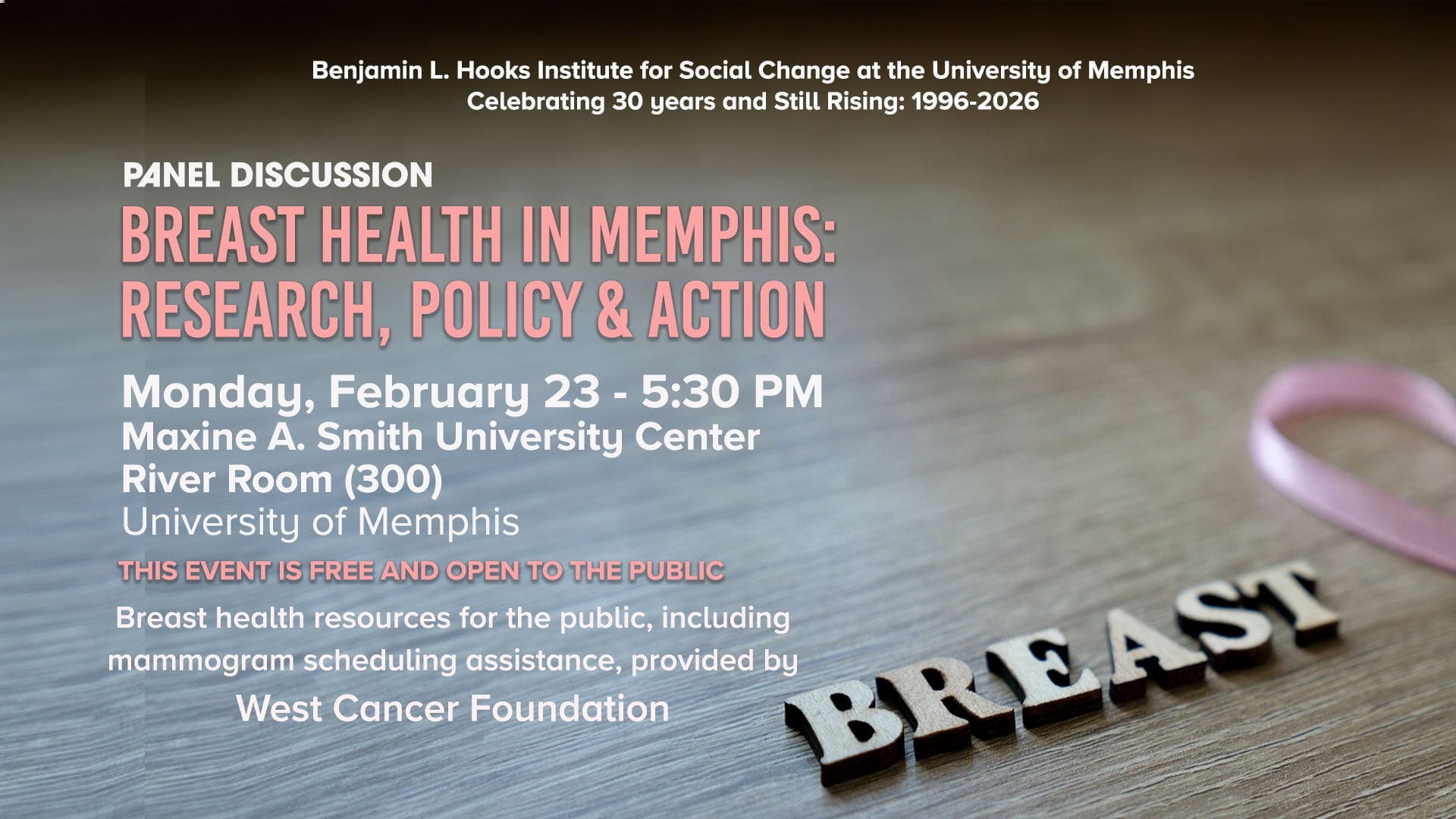
Feb. 9, 2026 ̶ The Benjamin L. Hooks Institute for Social Change at the University of Memphis continues its commitment to improving community health by convening a public forum on breast health wellness in Memphis. On Feb. 23 at 5:30 p.m., researchers from the University of Tennessee Health Science Center (UTHSC) will present research findings and policy recommendations on breast cancer outcomes during a panel discussion held at the Maxine A. Smith University Center River Room (Room 300).
The event will also mark the release of the Hooks Institute’s Winter 2026 Policy Papers, titled “Breast Cancer Mortality in Memphis: A Holistic Approach — Research Findings and Strategies for Improved Outcomes in Segregated Communities.” The program is free and open to the public.
The research and corresponding Policy Papers were funded by a 2022 grant from the National Institutes of Health (NIH). The research team includes co-investigator Professor Jill Dapremont, PhD, University of Memphis Loewenberg College of Nursing, University of Memphis and UTHSC research team Shelly White-Means, PhD, principal investigator; and co-investigators Arash Shaban-Nejad, MSc, MPH, PhD and Minghui Li, MSc, PhD.
Dr. Elena Delavega, professor in the School of Social Work, and Daphene R. McFerren, JD, executive director of the Hooks Institute, served as NIH sub-awardees and are the permanent editors of the Policy Papers. In these roles, they collaborated with UTHSC researchers to translate research findings into accessible articles for communities in Memphis and beyond.
“With more people having access to this research, I am hopeful that mortality from breast cancer will decline and that proactive approaches to improving breast health will increase in the immediate future,” said Dr. White-Means.
McFerren added, “The Hooks Institute Policy Papers on breast health advances our mission to harness university scholarship and community engagement to drive social change and improve socioeconomic conditions, health, education and overall well-being in our communities.”
Despite 25 years of progress in awareness, research and treatment, breast cancer remains the second leading cause of cancer-related deaths among women in the United States. Research conducted by UTHSC shows that Black women in Memphis and Shelby County have been twice as likely to die from breast cancer as white women, underscoring the urgent need for targeted interventions and policy action.
In addition to the panel discussion, West Cancer Foundation (Memphis, Tenn.) will provide breast health resources to the public, including assistance scheduling breast cancer screenings, transportation to and from oncology appointments, and access to additional supportive services. The date, time and location of the screenings will be coordinated and managed by West Cancer Foundation.
Cole Scroggins, community outreach specialist for the Hooks Institute, coordinated the partnership with West Cancer Foundation to make free screenings available. Scroggins said they “hope that this event will raise awareness of the programs already available in this community, and inspire individuals, providers and local leaders to work collaboratively to address these disparities and break down barriers to affordable care.”
The 10th volume of the Hooks Institute Policy Papers, along with the Winter 2026 edition and previous volumes, will be available on the Hooks Institute’s website at memphis.edu/benhooks.
Details:
Who: The Benjamin L. Hooks Institute for Social Change, UTHSC, the UofM Loewenberg College of Nursing and the West Cancer Foundation
What: Policy Paper Panel Discussion and Q/A – open to the public, free of charge
When: Feb. 23
5:30 PM–6 PM Public Reception with light refreshments
6 PM–7 PM Researchers Panel Discussion
6 PM–7 PM Sign Ups with West Cancer Foundation
Where: Maxine A. Smith, University Center – River Room (499 University St, Memphis, TN 38152)
About the Benjamin L. Hooks Institute and Policy Papers
The Hooks Institute Policy Papers cover topics ranging from socio-economic issues, health, and other inequities, criminal legal reform and community well-being to the impact of artificial intelligence on marginalized communities. The ten editions of the Hooks Institute’s Policy Papers, from 2014 through 2025, are now housed in the Library of Congress, Washington, DC.
The Benjamin L. Hooks Institute implements its mission of advancing social change and strengthening democracy through research, service and historical preservation. Institute programs include community outreach; funding faculty research initiatives on community issues; implementing community service projects; hosting conferences, symposiums and lectures; and promoting local and national scholarship on civil and human rights. The Hooks Institute is an interdisciplinary center at the University of Memphis. Contributory support for the Hooks Institute, including funding from individuals, corporations and foundations, is administered through the University of Memphis Foundation, a 501(c)(3) organization.
About UT Health Science Center
The mission of the University of Tennessee Health Science Center is transforming lives through collaborative and inclusive education, research, scholarship, clinical care, and public service. With six colleges – Dentistry, Graduate Health Sciences, Health Professions, Medicine, Nursing, and Pharmacy – at its main campus in Memphis, in addition to educational and clinical campuses at major hospitals in Memphis, Knoxville, Chattanooga, and Nashville, and sites across the state, UTHSC strives to fulfill its vision: Healthy Tennesseans. Thriving Communities. For more information, visit www.uthsc.edu. You can find the University of Tennessee Health Science Center on Facebook, Instagram, LinkedIn, X, and YouTube.
About West Cancer Foundation
West Cancer Foundation is dedicated to advancing the fight against cancer by providing patient resources to improve treatment and recovery, early detection and education to reduce critical cancer outcomes, and community-based research to improve health inequities. WCF provides breast and prostate cancer screenings, transportation to and from oncology appointments, mental health counseling for patients and caregivers, post-mastectomy care, lymphedema garments, and through its Sweet Wig Beauty Boutique, free wigs, head coverings, hats and scarves. All programs are provided through grants and generous donors at no cost to the patient.
For more information, visit memphis.edu/benhooks
Media Contact:
Amy Ruggaber, Assistant Director
The Benjamin L. Hooks Institute for Social Change
University of Memphis
krggaber@memphis.edu
(O) 901.687.3655