


Spring 2026 Commencement Spotlight
Alisha Coleman-Kiner, College of Education
Keeping a promise. Maintaining relationships. Leading by example.
For 30 years, Alisha Coleman-Kiner has done all three — as a teacher, principal, district leader and, on May 9, as Dr. Alisha Coleman-Kiner.
Coleman-Kiner will walk across the stage at FedExForum to receive her doctorate in Education in Leadership and Policy Studies from the University of Memphis.
Coleman-Kiner’s foray into education came at the request of her father. She mused that her dad’s request wasn’t a hard sell, because she enjoyed learning, and during that last semester, she fell in love with teaching — literally. After a 30-year career in education and mulling over retirement, she fulfilled her promise to her mother by returning to the UofM to finish her doctoral degree.
She originally wanted to be an attorney. She majored in English at the University of Tennessee at Martin. Her father pushed her to get a teaching certification as a safety net.
Student teaching fit Coleman-Kiner’s personality perfectly. “I enjoyed being challenged in that way,” she said. “I realized teaching required many of the same skills I loved about law: communication, critical thinking, persuasion and relationship-building. I just happened to find those things in a classroom instead of a courtroom.
Coleman-Kiner began her teaching career as a substitute teacher, securing her first long-term position at Booker T. Washington High School (BTW). Next, she started an eight year teaching career at Trezevant High School. She served as the cheerleading sponsor while the first all Black cheer squad won the national championship.
During her tenure at Trezevant, Coleman-Kiner enrolled in a master’s program in Educational Administration and Supervision at the University of Memphis, which augmented her practical experience with education development. “I have always been a Tigers fan,” she said. “Ever since high school, I have loved the University of Memphis and what it represents for this city.”
While on campus Coleman-Kiner would see former students and noted how those moments were some of the most rewarding parts of her journey. “There is something incredibly special about walking across a college campus and seeing former students thriving in that environment. Some of them were students I taught years ago, and others were students I served as a principal or district leader.”
These moments of connection are special to Coleman-Kiner.
“Many of them have reached out over the years to thank me, and those conversations mean more to me than any title or recognition ever could. Often, they remember small moments that I may not even have realized were significant at the time. A conversation, encouragement, high expectations or simply someone refusing to give up on them,” she said. Some of her former students “shared that seeing someone who looked like them leading schools, setting high standards and believing they belonged in advanced spaces changed how they saw themselves and what they believed was possible for their future.” The connection to Memphis — and to the students she served — would define every role that followed.
Coleman-Kiner transitioned into an assistant principal role at BTW, under the same principal who mentored her as a substitute teacher. In this role at BTW, Coleman-Kiner latched onto the hunger for knowledge her students had. As a Title I school — a school that receives federal funding to support a high percentage of students from low-income households — BTW’s students yearned for success. “They wanted to be great, and they were honest about it,” she said.
Coleman-Kiner became principal in 2005 with a focus on building a foundation — with the master’s degree and her experiences to guide her. “I was absolutely blessed to have the right faculty at the right time to come in and be partners and work with me. They were the aunts and uncles. I was the mama and we just loved our kids and did the best we could do for them,” she said. Building relationships with the administration, faculty and students was extremely important to her.
She noted the discerning nature of the students. “If your love for them is not authentic, and you don’t truly care about them, it will show up in their behavior,” she said.
During her 13 years as principal, Coleman-Kiner and her team worked to change the culture of the high school. In 2007, the graduation rate was 55% and rocketed to 82% by 2010. This success was fostered by same-gender freshman classrooms, increased teacher effectiveness, bringing down high teen pregnancy, violence rates and creating an atmosphere where the students felt cared for.
In 2011, BTW applied for the Race to the Top High School Commencement Challenge — a competition for high schools to demonstrate how they best prepare students for college and a career. The school was selected as one of six finalists out of 600 qualifying institutions. The White House featured videos of each finalist on its website, and the public voted to determine the winner. Memphis City Schools created its own marketing campaign to promote voting links for the high school. Local media followed the competition and some outlets did features on students and the school. On May 9, then Vice President Joe Biden called Coleman-Kiner to congratulate her and BTW for winning.
President Barack Obama visited with the graduating class on May 16, 2011, before giving the commencement speech. Coleman-Kiner called the day an “out of body experience.”
The win cemented all of the work the team was doing day in and day out for the students. Coleman-Kiner describes herself as an introvert, and found all the national attention overwhelming, however, showing off the success of the school, administration, faculty and students was the real prize.
Following the commencement address, Coleman-Kiner wrote an op-ed for Education Week titled “Leading with Love at Booker T. Washington” — a testament to including love in education. Coleman-Kiner acknowledged that “people talk about loving children like it’s automatic, but loving other people’s children well takes intention, patience and commitment. That love matters in education.” The staff at BTW who loved each student as their own were integral to the success and winning the Race to the Top challenge.
During this whole experience, Coleman-Kiner was back at the UofM working on her doctorate. “I chose the University of Memphis because Memphis is home. My entire career has been rooted in serving students and families in this city, so it mattered to me that my doctoral work also stayed connected to the community that shaped me as an educator and leader, so returning to earn my doctorate here felt personal,” she said. “The University of Memphis gave me the opportunity to study leadership while remaining deeply engaged in the real work happening in urban schools every day. I wanted a program that would challenge me intellectually while also honoring practical experience, relationships and the realities of leading schools in Memphis.” Her years on Memphis’ campus — and in the classroom — began sharpening an idea that would eventually become the heart of her research.
Coleman-Kiner completed a few additional courses and started on her dissertation, “The Heart of Leadership: Enacting Relational Equity in Urban High Schools.” She emphasized valuing relationships and understanding the environment to have success. She noticed principals were “making the right moves as leaders, but not getting the results and that gave me pause, because they were lacking the relationships needed.”
“When I was at BTW, when kids finished the test and I said, whose test did you take today? ‘They would say, I took Mr. McKinney’s test today.’ Mr. McKinney was the Algebra 1 teacher. They didn’t call it Algebra 1. They attributed that test to Mr. McKinney because it meant something to them to do that work.”
For other principals, Coleman-Kiner said, “There weren’t many students saying, ‘I took this teacher’s test’ or ‘that teacher’s test.’ Instead, it was just, ‘Oh yeah, it was math.’ That made me start questioning the disconnect.” She said those observations led her to believe some leaders approached education with more of a business mindset rather than leading with relationships and care.
Her dissertation, a qualitative multiple-case study, examined how three urban high school principals in historically under-resourced communities achieved sustained academic growth by integrating equity-centered leadership practices across relational, cultural, emotional and instructional domains. Her findings emphasized that strong relationships and relational trust are foundational to education, influencing how students and educators experience accountability, support, belonging and school improvement.
Dr. Nikki Wright, assistant professor in the College of Education (COE)’s Department of Leadership, guided Coleman-Kiner through the dissertation process. “She provided clarity, structure and steady support throughout one of the most demanding parts of the doctoral journey. Dissertation work can feel isolating at times, but Dr. Wright helped make the process feel manageable and meaningful. Her guidance helped me bring my vision and research to life in a way that honored both scholarship and the lived realities of the communities I serve.”
One year into her role as Deputy Chief of Academics at MSCS, Coleman-Kiner remains focused on building and retaining relationships.
“Leadership matters because people shape culture, and culture shapes outcomes,” she said.
For the district’s next summer institute with principals, she plans to lead workshops on the importance of relationships in education, drawing on her doctoral research to assist them in impacting student outcomes.
But Coleman-Kiner’s path to that research wasn’t a straight line.
Coleman-Kiner was energized by the momentum and success surrounding the Race to the Top High School Commencement Challenge, but she also faced the challenge of balancing a demanding career, growing national recognition, and a doctoral program while raising her six-year-old as a divorced mom and helping her father care for her mother after a car accident left her debilitated. In the midst of that challenge, her father died a year after her mother’s car accident. After finishing her doctoral coursework Coleman-Kiner admitted to her mother that she needed a break, and she was going to pause on pursing her doctorate. Her mother made her promise to go back and finish her degree.
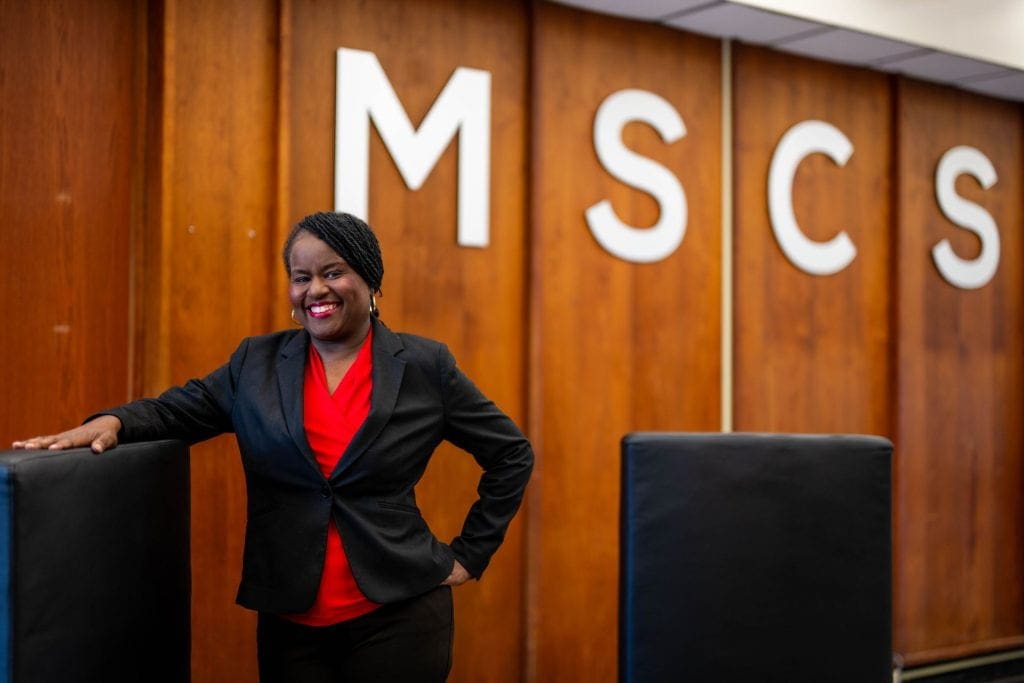
Despite the pause in her education, Coleman-Kiner moved into a new role in the Memphis-Shelby County School (MSCS) system as a principal supervisor and network coach in 2018. “It was a completely different experience and I really did enjoy coaching principals in this role,” she said.
After the death of her mother in 2019, Coleman-Kiner continued to support other principals in her roles in the district office — accepting each new challenge offered to her. In late 2023, the time had come for Coleman-Kiner to complete her doctoral program.. With support from Dr. Beverly Cross, the Lillian and Morrie Moss Chair of Excellence in Urban Education and Wright, Coleman-Kiner restarted her doctoral journey.
“Dr. Beverly Cross was one of the professors who most deeply impacted me. There were moments during this journey when I was exhausted, overwhelmed and honestly questioning whether I should continue. But Dr. Cross would not allow me to shrink back from the work or from who I was becoming in the process.”
“She challenged me to push beyond what I thought I could do academically, intellectually and personally. More than that, she spoke directly to my soul. She saw me, not just as a student sitting in a classroom, but as a Black woman, a leader, an educator and a person carrying decades of responsibility, service and sacrifice,” Coleman-Kiner said. Cross’ support provided the catalyst she needed to continue her work.
“Dr. Cross saw me beyond the classroom. She understood both the responsibility I carried and the potential she believed I still had. When I wanted to quit, she pushed me to keep going.”
Coleman-Kiner had unwavering support from colleagues — Tara Harris, Josh Bush and Jocelyn Mosby — the relationships they built and maintained as educators together were her sounding board and affirmation throughout the writing process. And as she crosses the stage on May 9, it isn’t lost on her how all of the relationships she’s cultivated have also impacted her. For those in similar hats, who may want to quit their program, she advises to “go ahead and finish. Take the time to rest, but don’t quit.”
“I’m really glad that I kept my promise to my mom and I think that’s the part that’s really important. My daughter is more excited than I am, and I am excited at how proud she is of me,” Coleman-Kiner said, acknowledging that her parents had been in the audience at her high school, undergraduate and graduate degree commencements and how her daughter would be in in the stands cheering her on.
Teachers and those in education — their work is important, Coleman-Kiner noted.
“Everybody who is anybody had a teacher. And that impact is greater than what I think we truly realize. There is no way we can truly minimize the impact of teachers and educators who sacrifice for their students,” she said. Coleman-Kiner encourages students and teachers alike “to go make a difference, build relationships and contribute to society that makes us and Memphis proud.”
“As educators, we plant seeds and often do not get to see the full harvest. So, encountering former students who are confident, successful and pursuing their dreams, feels like a full-circle moment. That, to me, is the real legacy of education,” she said.
Retirement may be on the horizon, but it isn’t in Coleman-Kiner immediate future, yet. “As long as I can contribute, impact or help someone achieve their goals, I think I should still be here trying to do that.”