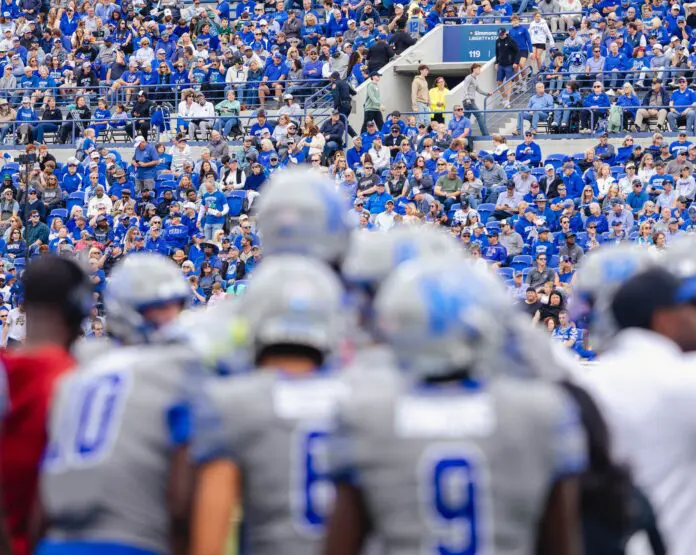
The University of Memphis Athletics Department is strengthening athlete development both on and off the field. Through comprehensive training programs in financial literacy, professional and personal development, leadership, career readiness, and community service, the UofM is building a holistic athlete.
These efforts are being noticed on the legislative level, including being praised by Congressman David Kustoff at a recent House Committee on Ways and Means hearing on the growing sports industry.
“What’s always been meaningful for me in the student-athlete development space is we are here to care about them in spite of their sport and what they do,” Lauren Hillman, director, of Athletics Career Readiness and Academic Advising said. “In a lot of ways, what we do impacts retention. Because the experience that they have here and the relationships that are built, whether its academic advisors or within student-athlete development, is really important because we’re the people who are trying to help them grow outside of sport and I think students get that and to me that’s meaningful and the outcomes from that are seeing students impacted and them knowing there’s a unit pouring into them and preparing them for what is next.”
This begins as soon as they start at the UofM through ACAD 1100, a course where student-athletes learn how to choose a major and what those majors looks like in terms of careers and career outcomes. The course also teaches career prep techniques such as resume creation, job interview best practices and even building your professional brand on LinkedIn.
“We’re just trying to be more intentional from the beginning,” said Hillman.
As a team, the unit works with student-athletes on developing benchmarks to work toward. And tailoring programming and coursework to correspond with hitting those benchmarks while connecting with the vast resources already available on campus such as Avron B. Fogelman Center for Professional Career Development, Career Services, and the Department of Leadership.
“I think one of the successful outcomes has just been the connection to on-campus resources and the ability to be so much more confident,” Destin Gilbert, director of Student-Athlete Development, said. “If a student-athlete comes up and is like, ‘I really want to own my own business or start my own business. What could we do to start going down that path?’ Whether it’s from alumni relations or from the entrepreneurship center, just going there and telling student-athletes, ‘We have this thing available on campus. Let’s try to make this happen.’”
The M Club, the athletic alumni of the UofM, has also been an integral partner. Through exposing student-athletes with speakers, workshops, programming, and networking opportunities that involve former student athletes and leadership across the city.
“Quite literally, when I worked in football, you could have somebody that was on the sidelines at practice in a ball cap that you thought was just this guy — a regular guy — but it would have been somebody who is a top dog at FedEx or International Paper,” Hillman said. “So just educating our student-athletes on who’s here and what’s available. Many of those people are in really powerful and impactful positions and are Memphis graduates. Trying to network with them and make sure they know and understand the opportunities that are available here within the community.”
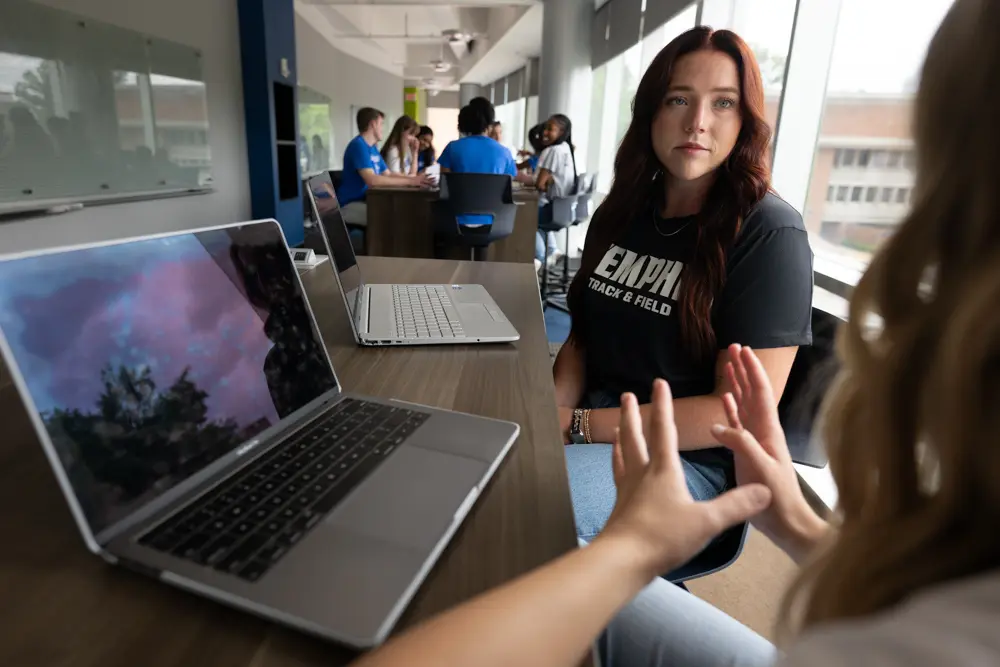
Both Gilbert and Hillman highlighted how the University and the city are interwoven and the opportunities that exist to make an impact in the community through community service.
“When you’re in a smaller place where literally the town is just sport, that’s where your identity is,” Hillman said. “I think Memphis is a good example of how we want our student-athletes to see themselves. Memphis doesn’t have just one identity. We’re so deep, and there’s so many layers to the city and who we are. It’s a good example for our student-athletes to see that they can be an athlete, but they can also be an artist or a musician or a businessperson or whatever. I think the city very much represents how we want our student-athletes to see themselves — they are not just one individual person who has one thing to offer.”
The team is continuously adding new programming based on feedback from student-athletes on their needs, including a survey last fall, to gage some of their interests.
“We found that a large majority of our female student-athletes were interested in in-person leadership development, so we’re working with the Department of Leadership to really flush out a pilot program to where we could get in and understand how to develop these young women into powerful leaders on the field and outside of the field to play,” Gilbert said.
In addition, financial literary is at the core of student-athlete development and is even more so integral with the launch and rollout of Name, Image and Likeness (NIL).
Student-Athlete Insights’ 2025 year-end NIL report showed what athletes wished they understood before their first deal which included: contract negotiations (58%), time commitment reality (51%), and how to say no professionally (44%). In addition to “the tax surprise: 51% of athletes with $5K+ in NIL income had unexpected tax situations.”
“There’s no such thing as too much financial education,” Camie Cole, assistant athletic director, Name, Image and Likeness said. “You want these athletes to leave feeling like they’ve gotten a really good grip on things. They come from all different walks of life. You have kids coming in with full financial teams — they have all of it. However, you also have the athletes that have never had to think about these types of things, and so they need everything, and so what we try to do is build it to where everybody has at least a base level.”
The team starts off with budgeting 101 — how to create a budget, identify one long-term savings goal, and look at the various types of expenses such as what’s a set expense versus a variable expense.
Cole said, “You have to make them realize this is going to be about 10 years. What are you going to do with the other 80 years of your life? Are you going to work for 80 years or are you going to set yourself up to where maybe you work another 10-20 years. It’s kind of making them realize that it’s a very narrow window — and there’s a lot more — and life afterwards that you have to look at. How are you going to use your present situation to set yourself up for your future? And then, if all of it goes away tomorrow, are you able to afford rent for two to three months?”
Financial planning is based on a five-year map, an increase from the previous four-year map, which is launching this fall.
Student-athletes also get the opportunity to meet with a financial advisor for free as part of their first meeting with the ability to hire one if they choose to continue sessions.
Then there’s the financial literary course in partnership with Robinhood through Money Drills, an experimental financial literacy course designed to help students, particularly student-athletes who are receiving NIL opportunities, learn to manage the earnings they receive.
So, in total among the offerings for student-athletes one is a mandatory session per semester, and two are highly recommended sessions per semester, in addition to those courses which student athletes can earn coursework credits.
Beyond day-to-day coursework and financial training, the University’s commitment to holistic development also extends into cutting-edge faculty research. As a Carnegie R1 university this is also part of the student-athlete programming at the UofM.
Grant funding upwards of $15,000 is available to faculty who have interest in research projects that are student-athlete focused. Two research projects are currently funded including Tiger Bites, a program for student-athletes to help with their nutrition needs led by Mary Catherine Schallert, clinical associate professor in the College of Health and Human Sciences. And Dr. Kibaek Kim, assistant professor of sport and entertainment management, is leading a study on the international student athlete experience.
“No matter how long they’re here, when they look back on their time, we want them to say, ‘You, you know what … they really tried to get me to be a part of the student experience at Memphis.’ And making sure that they don’t lose that part of being a student. Making sure that they’re gaining the skills and the knowledge necessary to then transfer everything that comes with being a student-athlete and those large benefits to actually having some real-world application when they’re done playing their sport,” Gilbert said.