

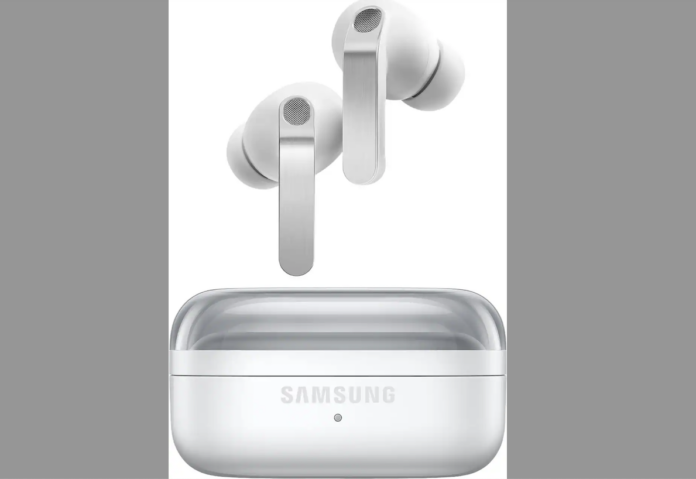
Industry innovation and clinical research expertise at the UofM make way for Samsung’s Galaxy Buds Hearing Aid Feature
The University of Memphis Hearing Aid Research Lab was one of three clinical validation study sites, along with Vanderbilt University Medical Center and San Jose State University, who conducted research on Samsung Electronics Co., Ltd. Galaxy Buds hearing aid feature which has recently received U.S. Food and Drug Administration (FDA) clearance.
The FDA-cleared feature allows compatible Galaxy Buds to function as over-the-counter hearing aids for adults with perceived mild-to-moderate hearing loss. Samsung announced that users “can also diagnose their hearing with the Galaxy Buds Hearing Test feature, which is registered as a Software as a Medical Device (SaMD) and provides medical-grade results.”
“Hearing loss is very common, but many adults who could benefit from hearing technology never pursue traditional hearing aids. There are a lot of reasons for that, including cost, access to care, stigma and simply not feeling ready to identify as someone who needs a hearing aid,” Dr. Jani Johnson, associate professor in the UofM School of Communication Sciences and Disorders and director of the Hearing Aid Research Lab said.
According to the World Health Organization by 2050, 2.5 billion people are projected to have some degree of hearing loss, and more than 700 million will require hearing rehabilitation.
“Technology like this creates another potential entry point. Someone may already own and be comfortable using earbuds, and the ability to access hearing assistance through a familiar consumer device may feel more approachable. It doesn’t replace comprehensive hearing healthcare when that is needed, but it can expand the range of options available to adults with hearing loss.”
Dr. Johnson said that access is particularly important to residents in the Mid-South due to proximity to an audiologist or financial barriers.
“What excites me most is the possibility of giving people more choices and, ultimately, better hearing care. We’re seeing innovation across the entire spectrum of hearing technology. Consumer devices are creating new entry points for people who might not otherwise seek hearing care, while advances in artificial intelligence and other technologies are also driving substantial improvements in traditional hearing aids,” Johnson said. “Those advances have made the tools available to audiologists increasingly sophisticated. Hearing aids are getting better at adapting to complex listening environments, supporting communication and usability, and allowing clinicians to personalize technology to an individual patient’s needs and preferences. So, to me, the exciting story is that technology is expanding what we can offer, both within and outside of the traditional hearing healthcare model.”
UofM’s involvement in the clinical validation study began in June 2025 after members of the Samsung Research America team visited the UofM lab and saw firsthand the specialized facilities and equipment, as well their expertise in hearing aid fitting and evaluating hearing technology with people who have hearing loss. The University’s involvement with the project continued through March 2026.
“New technologies can be developed in a lab, but clinical validation is an important step in understanding how well they actually work for people with hearing loss,” Johnson said. “And there is something particularly meaningful about having this work happen in Memphis. People from our community participated in research that helped evaluate a technology that will now be available much more broadly. It gives our participants, students, and the University a role in shaping what the future of hearing healthcare looks like.”