

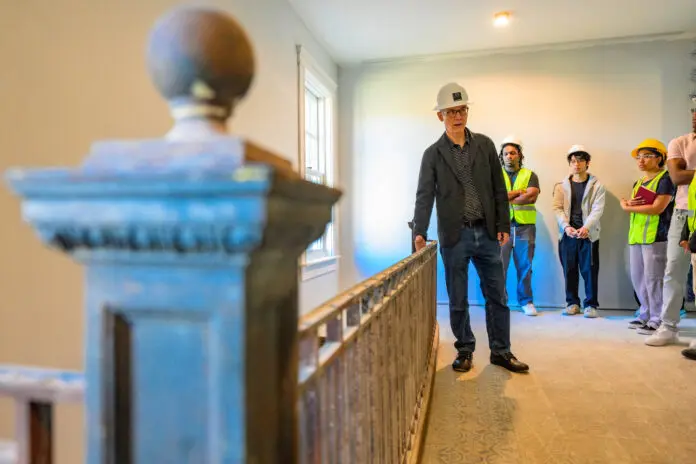
The integration of professional development and architectural education through the “Shop Talk” series in the Department of Architecture at the University of Memphis is allowing architecture students to learn and observe the ongoing impact of construction and the local industry partnerships involved with the renovation of Mynders Hall.
Built in 1912, Mynders Hall is one of the first three buildings constructed at the University of Memphis which was at that time the West Tennessee Normal School. Seymour Mynders, the first president of the school named the building after his daughter, Elizabeth, who died in 1912. Shaped as an “E” in her honor, Mynders served as a women’s residence hall until 2015.
The more than 100-year-old building has been undergoing a renovation that will modernize the space for new offices and research space.
The Shop Talk series serves as a dedicated professional development window for architecture students.
Professor Michael Hagge, M.Arch, MCRP, chair of the Department of Architecture said, “The Shop Talk series was created to provide professional development opportunities to all students in the Department of Architecture.” The topics have ranged from discussions on building codes, lighting design, and design, among others.
Establishing Mynders Hall as a reoccurring Shop Talk was brought forth by the American Institute of Architecture Students (AIAS) at the University of Memphis.
“As President of the American Institute of Architecture Students (AIAS) at the University of Memphis, one of my priorities is creating opportunities for students to learn outside the classroom,” said Celeste Rodriguez, a first-year Master of Architecture student. “Young designers need to see what they are learning in the classroom in real life. The Mynders Hall site visit gives students a unique opportunity to explore a historic building, learn about how the profession has evolved and better understand the challenges when designing to preserve the historical character of a building. This type of experience can be extremely beneficial for the growth of a student, as they can appreciate firsthand what architects do in the field.”
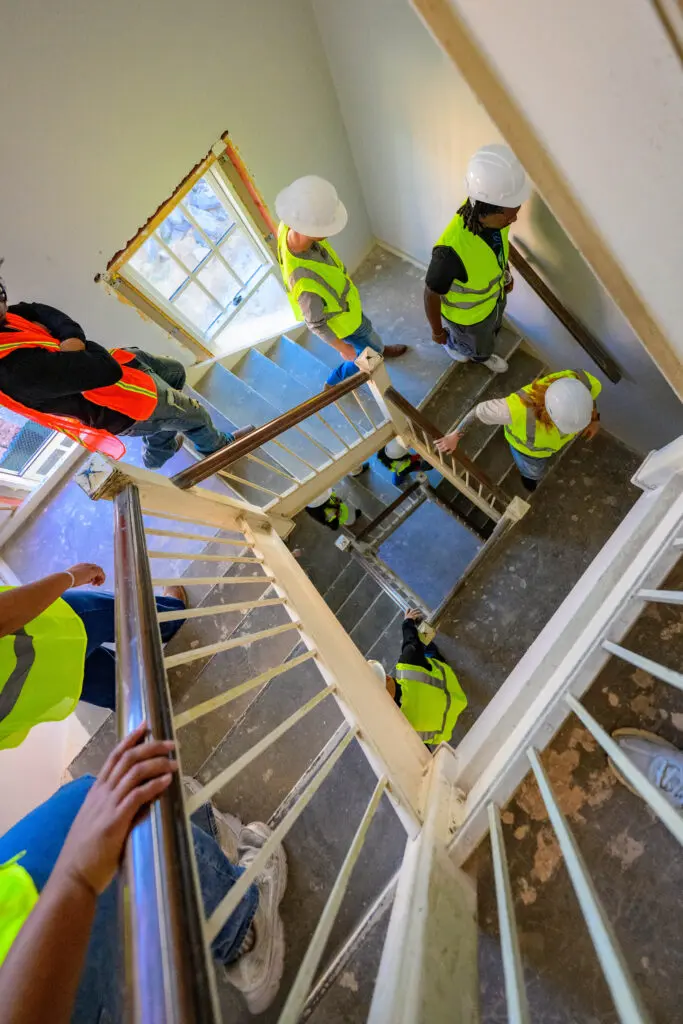
Photo by Matthew A. Smith/The University of Memphis
The department partners directly with LRK on hosting the series. Speakers and presenters have included Jonathan Smith, senior associate at LRK and the project manager for Mynders; Peter Palazola, project executive at Montgomery Martin Contractors LLC and project leader, construction for Mynders; Gargi Talati, structural engineer at Burr & Cole; UofM architecture + interior architecture alumna Jaemi Kurtzman, interior designer at LRK; and UofM interior design alumna Lauren W. Kane, executive director of Space Planning, Utilization and Administration at the UofM.
“I think one of the things that was most interesting to them, the students, was to look at the way a historic building like Mynders has to be addressed in certain ways in order to maintain the historic character, so whether it’s the type of windows that goes back into it or updating the structural system – all the historic elements of it – adaptive reuse projects are really difficult. And when you look at Mynders, all the really beautiful historic details, a lot of which were covered up over the years, are being re-exposed and reconstructed in a lot of ways,” Hagge said. “They [students who have toured Mynders] saw firsthand, the way that buildings were being designed and constructed literally 100 something years ago.”
Since 2024, the Shop Talks series has held sessions about Mynders Hall on schematic design, design development, construction documents and most recently the construction phase with a presentation held Oct. 21 and a tour and walk-through inside Mynders on Oct. 23.
“I have been lucky enough to have gone to all of the Mynders Hall lectures and site visits throughout this series since it started my freshman year in undergrad. With every lecture and site visit, I have gained a deeper respect for the preservation of historic buildings,” Rodriguez said. “Architecture students are often focused on designing new buildings, but a series like this encourages students to critically think through the benefits of what already exists and how that benefits the community.”
Rodriguez said that one of the most interesting aspects of Mynders Hall is how it has kept its historic character and charm throughout the renovation. “I really appreciate how the exterior and interior will reflect the period when it was built, so that people can actually experience it even after the renovation. For example, the windows have been replicated exactly as they were in the past,” she said.
Among those historic elements which the renovation aims to balance with modern research needs is preserving features such as the decorative woodwork and tiles which are being salvaged and refinished rather than being replaced. Designers made strategic decisions on which finishes to prioritize and when budget constraints required peeling back certain design elements (for example, replacing the tiles would cost between $700-800 each to replace today). When it reopens, Mynders Hall will have air conditioning for the first time. The Tennessee Historical Commission provides oversight since the building is over 50 years old.
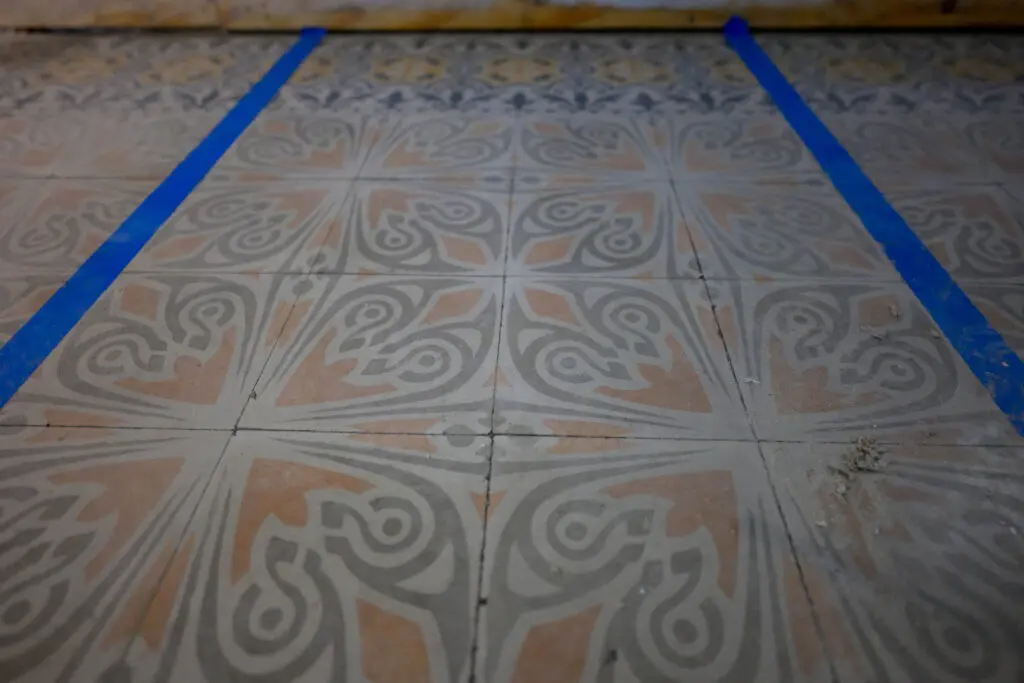
Photo by Matthew A. Smith/The University of Memphis
“As I enter into the profession, I want to approach every project with the same care for the relationship of architecture, history and its surrounding community. I believe I can take this thinking beyond historical renovation because it is important to evaluate the context, understand the needs of the user, and thoughtfully make decisions about materiality and its long-term use,” Rodriguez said.
The City of Memphis offers rich learning opportunities for students. Among the characteristics in Memphis architecture is the number of historic districts within the city — Memphis has 56 officially recognized historic districts. This allows the department to showcase examples and demonstrate sustainable historical building techniques in neighborhoods such as Central Gardens, Evergreen and the Annesdale-Snowden Historic District. Another is the mid-century modern homes within the city and the historic buildings downtown which the department has scheduled tours for students to partake in.
Located in Jones Hall, the Department of Architecture has been able to see the progression of Mynders Hall right outside their very window.
“One thing that’s interesting, at least for us, is because we’re located right next door to Mynders, we can see the construction out of one of our classrooms and out of our design studios,” Hagge said. “And so, in the beginning class that I teach, you know, we literally looked out the window and were pointing. ‘Look how they’re taking the windows apart,’ and so forth. So, you know, it’s been a really great learning experience.”

Photo by Matthew A. Smith/The University of Memphis
Hagge said through maintaining strong ties with their alumni, the Department of Architecture has been able to partner with local firms through design critiques where outside architects provide feedback to students in studio settings. Networking with alumni has also led to internship opportunities for students and positions in architecture firms upon graduation. The Department also partners with the Memphis component of the American Institute of Architects (AIA) to bring in guest lectures and provide further professional development opportunities for students.
“I am grateful that the Department of Architecture and AIAS provide students with learning opportunities like the Mynders Hall series that allow students to experience architecture beyond the textbooks,” Rodriguez said. “As an organization, AIAS tries to bridge the gap between architectural education and the profession through events like the Mynders Hall series. This series highlights the value of real-world learning experiences and the importance of giving students a space to ask questions.”