

[et_pb_section fb_built=”1″ admin_label=”section” _builder_version=”4.27.4″ background_color=”rgba(0,54,130,0.07)” animation_style=”fade” animation_duration=”400ms” hover_enabled=”0″ custom_css_free_form=”.et_pb_image_0_tb_body{|| display: none !important;||}||||.et_pb_text_3 blockquote {|| background-color: #fff;|| border-left: 5px solid #007BFF; /* Blue accent border */|| margin: 20px 0; /* Spacing around the blockquote */|| padding: 20px; /* Inner padding */|| box-shadow: 0 4px 8px rgba(0, 0, 0, 0.1); /* Subtle shadow for a modern look */|| border-radius: 10px; /* Rounded corners */||}||||.et_pb_text_3 blockquote h1 {|| font-size: 1.5rem; /* Adjust font size */|| color: #333; /* Darker font color for better contrast */|| text-align: center; /* Center-align the text */|| font-family: ‘Georgia’, serif; /* Elegant font choice */|| line-height: 1.4; /* Improve readability */|| margin: 0; /* Remove extra margin */||}||.et_pb_section.et_pb_section_0.et_section_regular {|| padding-top: 0px;||}||.et_pb_row.et_pb_row_1_tb_body {|| padding-top: 0px;||}||ow.et_pb_row_0 {|| padding-top: 0px;||}||||||/* styling tests */||||.et_pb_fullwidth_menu {|| background: #ffffff;|| box-shadow: 0 2px 10px rgba(0,0,0,0.05);||}||||.et_pb_fullwidth_menu ul li a {|| color: #000 !important;|| font-weight: 600;|| transition: color 0.3s ease;||}||||.et_pb_fullwidth_menu ul li a:hover {|| color: #0066cc !important; /* Accent hover color */||}||||.et_pb_fullwidth_menu .et_pb_menu__logo img {|| max-height: 50px;|| transition: transform 0.3s ease;||}||||.et_pb_fullwidth_menu:hover .et_pb_menu__logo img {|| transform: scale(1.03);||}||||||.et_pb_image .et_pb_image_wrap img {|| border-radius: 30px;|| box-shadow: 0 1px 5px rgba(0,0,0,0.08);|| transition: transform 0.3s ease;||}||||.et_pb_image .et_pb_image_wrap img:hover {|| transform: translateY(-3px);||}||||||/* transitions */||a, .et_pb_button, .et_pb_more_button {|| transition: color 0.3s ease, background-color 0.3s ease, transform 0.3s ease;||}||||a:hover {|| color: #0066cc;||}||||/* headings */||.et_pb_heading_container h1,||.et_pb_heading_container h2,||.et_pb_heading_container h3 {|| font-weight: 700;|| text-transform: uppercase;|| letter-spacing: 1px;|| color: #003087 !important;||}||||||||/* background enhances */||||.et_pb_section_0.et_pb_section {|| background-color: #00368212 !important;|| border-radius: 18px;|| background: #fff;|| /* border-radius: 8px; */|| box-shadow: 0 8px 24px rgba(0, 0, 0, 0.15);|| transition: box-shadow 0.3s ease;||}||||.et_pb_section_0.et_pb_section:hover {|| box-shadow: 0 10px 30px rgba(0, 0, 0, 0.2);||}||||.et_pb_row_1_tb_body{ || display: none||}||||.et_pb_row_0_tb_body {|| padding: 0 !important;||}||||.et_pb_row_2_tb_body {|| padding: 0;||}” global_colors_info=”{}” sticky_enabled=”0″][et_pb_row column_structure=”1_2,1_2″ _builder_version=”4.27.4″ _module_preset=”default” custom_margin=”|auto|-41px|auto||” global_colors_info=”{}”][et_pb_column type=”1_2″ _builder_version=”4.27.4″ _module_preset=”default” global_colors_info=”{}”][et_pb_image src=”https://news.memphis.edu/wp-content/uploads/2024/12/Christos-Papadopoulos-3.jpg” alt=”Man holds steering wheel to driving simulation as students watch.” title_text=”Christos Papadopoulos with students” align=”center” _builder_version=”4.27.4″ _module_preset=”default” custom_margin=”||||false|false” global_colors_info=”{}”][/et_pb_image][/et_pb_column][et_pb_column type=”1_2″ _builder_version=”4.27.4″ _module_preset=”default” global_colors_info=”{}”][et_pb_text _builder_version=”4.27.4″ _module_preset=”default” width=”100%” custom_margin=”|auto||auto|false|false” global_colors_info=”{}”]
The days of the simple automobile are long gone.
Today, our cars are essentially supercomputers on wheels, complete with advanced safety features like lane-change detection, automatic braking and even autonomous driving capabilities.
But all of these computers come with a host of potential problems.
Just like your phone, hackers can break into your vehicle. The difference with a hacker breaking into your car is they can cause actual physical damage, including harm to you or your passengers.
That’s where our automotive cybersecurity research comes in.
At its core, our research is people oriented.
[/et_pb_text][/et_pb_column][/et_pb_row][et_pb_row _builder_version=”4.27.4″ _module_preset=”default” global_colors_info=”{}”][et_pb_column type=”4_4″ _builder_version=”4.27.4″ _module_preset=”default” global_colors_info=”{}”][et_pb_text _builder_version=”4.27.4″ _module_preset=”default” custom_margin=”1px|||||” global_colors_info=”{}”]
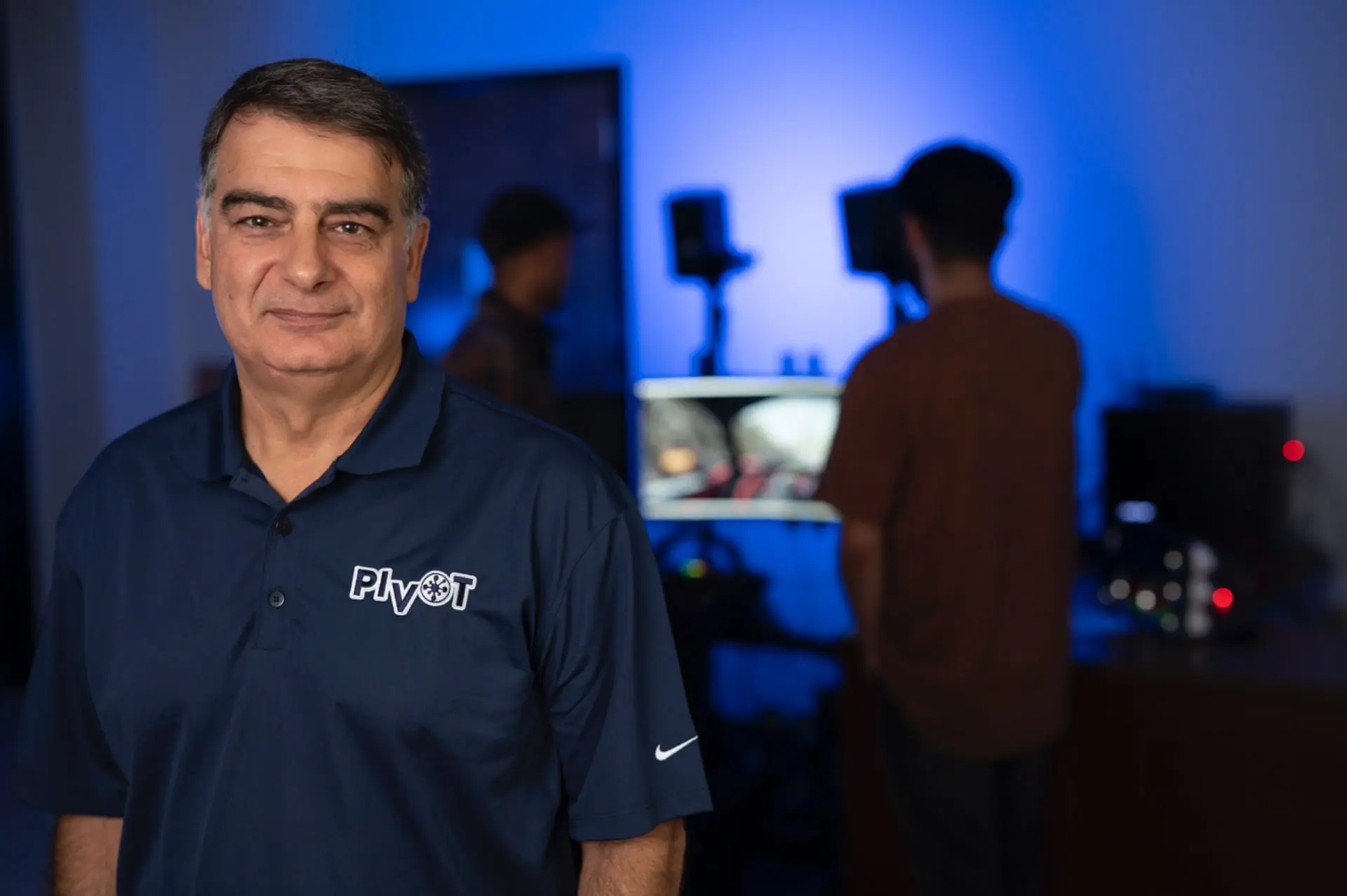
We want to protect passengers and restore drivers’ trust in their cars. I’m fortunate to have a team of students here at the University of Memphis who are helping to lead the charge in these critical safety efforts.
[/et_pb_text][/et_pb_column][/et_pb_row][et_pb_row column_structure=”3_5,2_5″ _builder_version=”4.27.4″ _module_preset=”default” min_height=”195px” custom_margin=”-34px|auto||auto||” global_colors_info=”{}”][et_pb_column type=”3_5″ _builder_version=”4.27.4″ _module_preset=”default” global_colors_info=”{}”][et_pb_text _builder_version=”4.27.4″ _module_preset=”default” width=”94.9%” min_height=”250.4px” custom_margin=”||-23px|||” custom_padding=”||0px|||” global_colors_info=”{}”]
Honing My Interest
While I’m originally from Cyprus, I came to the United States for college in 1985 and have never left.
Each step in my education affirmed my interest in digital security.
After completing my PhD, I joined the faculty at the University of Southern California, then moved to Colorado State, and now found my home here in Memphis. After spending about 20 years studying how to secure communication on the internet, I took a unique two-year stint at the Department of Homeland Security supervising projects concerning automotive security.
[/et_pb_text][/et_pb_column][et_pb_column type=”2_5″ _builder_version=”4.27.4″ _module_preset=”default” global_colors_info=”{}”][et_pb_text _builder_version=”4.27.4″ _module_preset=”default” text_font_size=”11px” header_font_size=”36px” header_letter_spacing=”2px” header_line_height=”1.2em” background_color=”RGBA(255,255,255,0)” max_width=”100%” min_height=”99.8px” custom_margin=”0px|0px||0px|false|false” custom_padding=”0px||||false|false” animation_style=”slide” animation_direction=”right” animation_duration=”1850ms” global_colors_info=”{}”]
“Each step in my education affirmed my interest in digital security.”
[/et_pb_text][/et_pb_column][/et_pb_row][et_pb_row _builder_version=”4.27.4″ _module_preset=”default” min_height=”139.4px” custom_margin=”-66px|auto||auto||” custom_padding=”||16px|||” global_colors_info=”{}”][et_pb_column type=”4_4″ _builder_version=”4.27.4″ _module_preset=”default” global_colors_info=”{}”][et_pb_text _builder_version=”4.27.4″ _module_preset=”default” custom_margin=”1px||22px|||” custom_padding=”0px|||||” global_colors_info=”{}”]
My experiences complemented each other well because cars are basically becoming computers. I learned about the problems the industry faced, and it continued to spur my research.
If I can secure a vehicle, I can save lives — it’s as simple and urgent as that.
[/et_pb_text][/et_pb_column][/et_pb_row][et_pb_row column_structure=”2_5,3_5″ _builder_version=”4.27.4″ _module_preset=”default” min_height=”480.1px” custom_margin=”0px|auto||auto|false|false” custom_padding=”0px||0px|||” global_colors_info=”{}”][et_pb_column type=”2_5″ _builder_version=”4.27.4″ _module_preset=”default” global_colors_info=”{}”][et_pb_image src=”https://news.memphis.edu/wp-content/uploads/2024/12/Christos-Papadopoulos-2.jpg” alt=”Man in simulation vehicle.” title_text=”Dr. Christos Papadopoulos” show_bottom_space=”off” align=”center” _builder_version=”4.27.4″ _module_preset=”default” width=”104.2%” min_height=”100px” height=”567px” custom_margin=”|0px|0px||false|false” custom_padding=”|0px|0px|||” global_colors_info=”{}”][/et_pb_image][/et_pb_column][et_pb_column type=”3_5″ _builder_version=”4.27.4″ _module_preset=”default” global_colors_info=”{}”][et_pb_text _builder_version=”4.27.4″ _module_preset=”default” custom_margin=”||0px||false|false” custom_padding=”|0px||0px||” global_colors_info=”{}”]
A Student-led Effort
While the work we’re doing is complex and cutting-edge, one of the things I love about my research is the fact that it’s so hands-on.
And in that regard, our graduate students are absolutely critical to our success. They are the ones doing the research, and quite frankly, we can’t do any of this work without them. Their energy, ideas and creativity are what make our research so effective.
One of the biggest challenges we face in this industry is getting access to the data we need.
Automakers are understandably hesitant to share data from their vehicles for a variety of reasons, so we’ve had to get creative in our approach.
We recognized that the best way to collect the data we needed was to simulate various driving conditions and terrains. Our students jumped at the opportunity to build the simulator.
One of my students, for example, loves gaming.
He was very excited about building a realistic simulator equipped with a steering wheel, pedals and a gear selector and asked me, “You mean, I can go out and buy anything?” I said yes, and I’m pretty sure that made his day. The students found the hardware and software we needed, and now we have a simulator to collect data and analyze driving conditions.
[/et_pb_text][/et_pb_column][/et_pb_row][et_pb_row _builder_version=”4.27.4″ _module_preset=”default” custom_margin=”21px|auto||auto||” custom_padding=”2px|||||” global_colors_info=”{}”][et_pb_column type=”4_4″ _builder_version=”4.27.4″ _module_preset=”default” global_colors_info=”{}”][et_pb_text _builder_version=”4.27.4″ _module_preset=”default” custom_margin=”0px||||false|false” custom_padding=”0px||0px||false|false” global_colors_info=”{}”]
This simulator was funded by a $1.8 million grant from the National Science Foundation (NSF) in partnership with the University of Southern California Information Sciences Institute and Colorado State University.
I’m incredibly grateful for their support of our project.
[/et_pb_text][/et_pb_column][/et_pb_row][et_pb_row _builder_version=”4.27.4″ _module_preset=”default” custom_margin=”-37px|auto||auto||” global_colors_info=”{}”][et_pb_column type=”4_4″ _builder_version=”4.27.4″ _module_preset=”default” global_colors_info=”{}”][et_pb_text _builder_version=”4.27.4″ _module_preset=”default” custom_margin=”||0px||false|false” global_colors_info=”{}”]
A Bright Future
The work we’re doing in automotive cybersecurity and privacy is incredibly important, and I encourage more students to join. Students will learn how to secure computers and how to work with machine learning, which is becoming more popular with self-driving cars.
We also dive into cyber-physical systems and sometimes even install sensors on the vehicles ourselves. Each concept is immersive; if you like learning through hands-on experiences, you may find a home in our lab.
The more students we can get involved in our lab, the more research we can conduct. The more we understand about vehicle security, the safer the cars, and roads, will be.
[/et_pb_text][/et_pb_column][/et_pb_row][et_pb_row _builder_version=”4.27.4″ _module_preset=”default” min_height=”115px” global_colors_info=”{}”][et_pb_column type=”4_4″ _builder_version=”4.27.4″ _module_preset=”default” global_colors_info=”{}”][et_pb_text _builder_version=”4.27.4″ _module_preset=”default” custom_padding=”15px|||||” global_colors_info=”{}”]
Research in a Minute is part of a series from the University of Memphis showcasing the innovative research being done by our faculty.
Watch Dr. Christos Papadopoulos’ Research in a Minute video below.
[/et_pb_text][/et_pb_column][/et_pb_row][et_pb_row _builder_version=”4.27.4″ _module_preset=”default” global_colors_info=”{}”][et_pb_column type=”4_4″ _builder_version=”4.27.4″ _module_preset=”default” global_colors_info=”{}”][et_pb_video src=”https://youtu.be/eEC5YD1O4B8″ _builder_version=”4.27.4″ _module_preset=”default” global_colors_info=”{}”][/et_pb_video][/et_pb_column][/et_pb_row][/et_pb_section]