

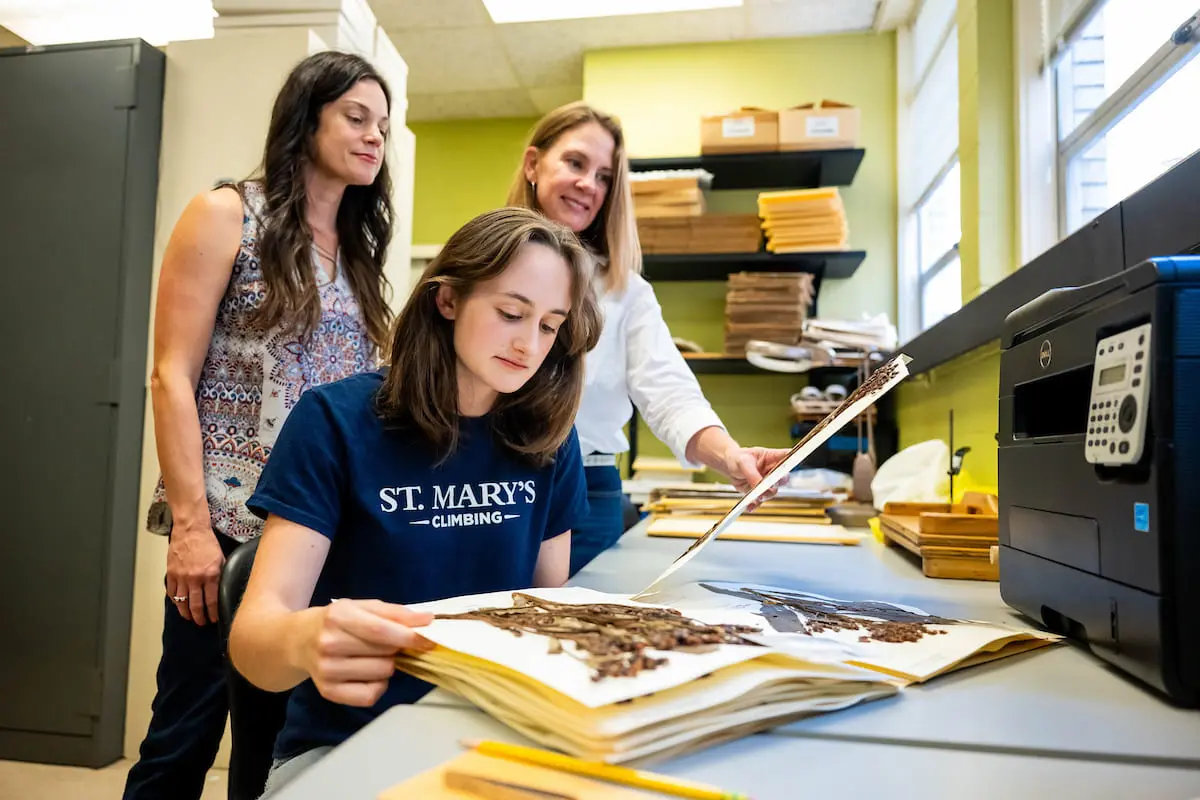
This past summer, St. Mary’s Episcopal School senior Lucy Roberts had a unique opportunity to gain hands-on research at the Institute for Agricultural and Conservation Research and Education (ACRE) through St. Mary’s Honors Independent Research Study (HIRS) program.
“St. Mary’s students who participate in HIRS benefit from working alongside faculty and students (undergraduate and graduate) in a way that allows them to experience how research is actually conducted at the collegiate level,” said Anna Bess Sorin, PhD, director of St. Mary’s HIRS program. “They learn, often surprisingly, how much time and effort it takes to plan and conduct research; to deal with the unknowns that arise and impact findings, the frustrations when things don’t work out, but also the excitement of discovery, especially when there are significant results.”
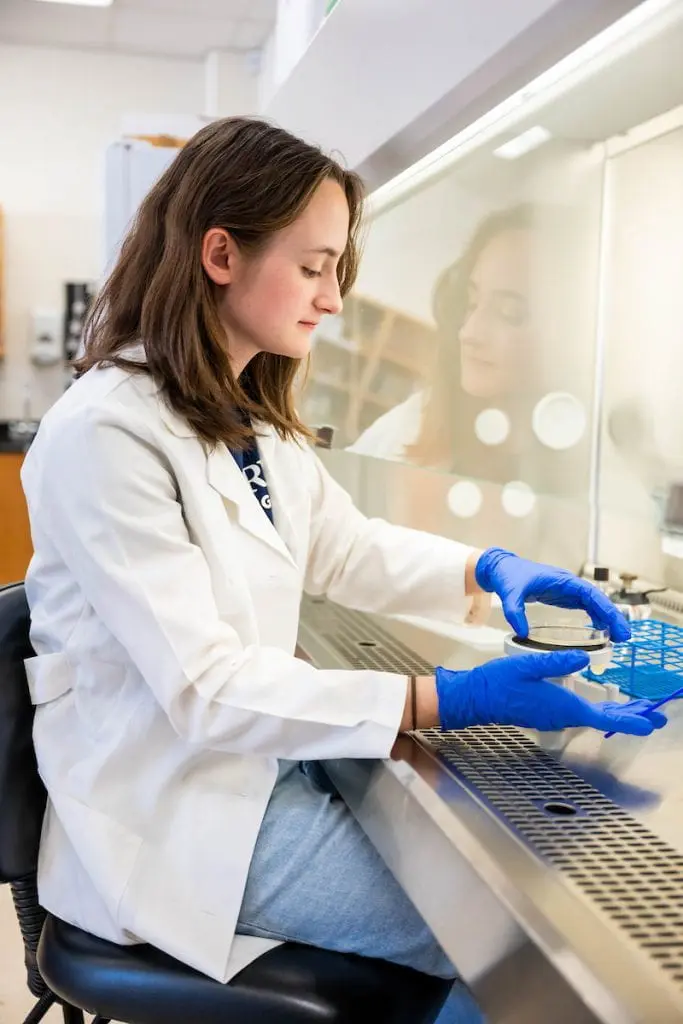
Photo by Matthew A. Smith/The University of Memphis
Roberts partnered with researchers including mentor Jennifer Mandel, PhD, ACRE director, on a project which began as a conversation to explore the intersection of biological sciences and public health.
“You never know what a casual conversation with another scientist who’s doing something very different from you could turn into, that’s why interdisciplinary research and collaboration is so important,” Mandel said.
That conversation involved Fanta Gutema, PhD, assistant professor of research in the School of Public Health and how the labs could explore plants and how they could be impactful in preventing infectious diseases.
So, Mandel and Roberts set out to answer that question and this spurred the idea to explore the antimicrobial properties of plants.
Thanks to the University of Memphis Herbarium, a natural history collection consisting of nearly 20,000 plant specimens from scientific collections from around the world, the pair had a multitude of plant specimens they could test at their fingertips.
“It’s hard for people to understand what the value of an herbarium is if they’re not in plants or in the sciences because it’s a room full of dried plant tissue,” Mandel said.
“I always remind people that we get DNA out of that plant tissue now and those plants were collected before we even knew what DNA was. It’s unimaginable what you may be able to do with this resource in 100 years.”
Roberts and Judy Bowen, MS, a microbiologist in the Mandel lab, spent three to four days a week in the lab together sorting through herbarium samples which Mandel said can be very tedious. “We didn’t give her a playbook; we didn’t stand over her. She figured out how to do it,” Mandel said. “She discovered how to do things since you don’t really figure out the scientific method until you are actually practicing it.”
“Students are impressed by the trust placed in them to carry out their work independently, once they have been trained, and how they are treated as meaningful contributors to the projects,” Sorin said. “The whole experience helps build their confidence while also exposing them to the high levels of research being conducted at UofM.”
One day Mandel said the serendipitous nature of science took place. Plant tissue that was collected by a former student researcher from Brazil for the purpose of DNA work more than 10 years ago, tested positive for antimicrobial properties for a Bacillus species of bacteria.
“It’s unimaginable what you may be able to do with this resource in 100 years.”
– Dr. Jennifer Mandel
Carolina Siniscalchi, PhD, was that student researcher who was at the UofM at the time for a one-year fellowship. She later completed postdoctoral research at the UofM from 2018-19. Today, Siniscalchi is an assistant professor and data science coordinator at Mississippi State University.
“I chose UofM because in 2014 Dr. Mandel published a paper about the application of a new DNA sequencing technique in the sunflower family that I was very interested in using in my own research questions,” Siniscalchi said. “I was introduced to Dr. Mandel through a researcher from the National Museum of Natural History, in D.C., Dr. Vicki Funk. Dr. Mandel and I soon established a great collaboration, that is still ongoing. In the first year I spent at her lab, I learned so much about DNA sequencing and data analysis. I was one of the first researchers in Brazil to use target-capture DNA sequencing techniques, and all thanks to the time I spent at UofM.”
Siniscalchi said it makes her happy to know that plant samples she took more than a decade ago are having an impact today and finding new life.
“It’s important to highlight that these millions of specimens distributed across the world are not easy to maintain. They need controlled temperature and humidity, special cabinets and people to curate and care for them. All this requires funds, which are usually scarce, as natural history collections are not usually seen as ‘modern’ science. I hope that with studies like this, we can show the value of preserving and caring for natural history collections,” Siniscalchi said.
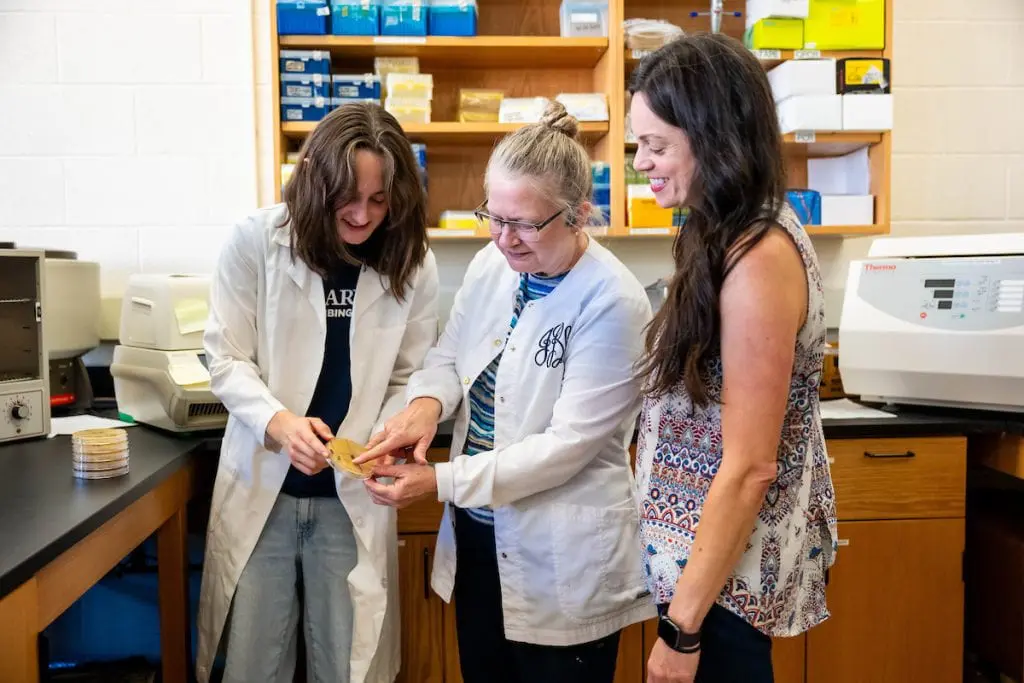
Photo by Matthew A. Smith/The University of Memphis
Roberts will continue the research project in the Mandel lab this fall to test against Staphylococcus (staph) bacteria.
Their next step is to partner with another lab in the UofM Chemistry department led by Timothy Brewster, associate professor, and Mike Brown, assistant professor, using chemical analytic methods available in their labs which separate out all chemicals to better examine the plant profiles and their chemical make-up.
The Department of Biological Sciences has mentored high school students over the years from University Schools, Collierville High School, White Station High School, Lausanne Collegiate Schools and Hutchison School.
Sorin said she hopes to expand the HIRS program with more local colleges and universities. “If students are aware of the opportunities that can be found in Memphis, ideally, more of our bright, talented students will remain and contribute to building a more vibrant community.”
“I see a lot of myself in these students,” Mandel said. “I was always interested in science and plants at a very young age, and I had a lot of great mentors. I wouldn’t be here without the background of having those mentors who helped me along the way.”
Q&A with Lucy Roberts
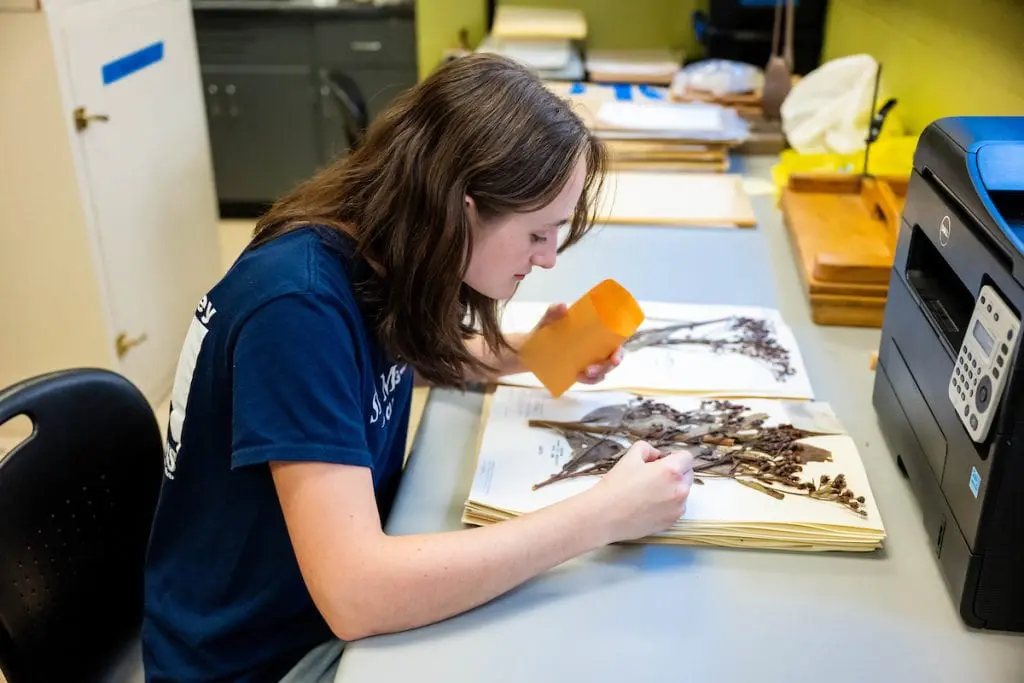
Photo by Matthew A. Smith/The University of Memphis
Q: What do you think you learned from this experience?
A: It was very independent. In the beginning, obviously, they were guiding me through the process and the procedure. But once I figured out how to do the actual experiment itself, I was very much on my own, which is cool. They weren’t checking up on me. And all the time I was in the lab by myself, it’s up to me to actually get the things done. I’m the one doing the experiment. No one’s going to penalize me for not going so it’s definitely beneficial to know I’m doing this for myself, not for a grade. And I definitely like that. I like that I had to motivate myself, just because I found it interesting.
Q: This research, this work…is it something you’re interested in pursuing in the future?
A: I definitely think so. I’ve liked the experience so far. Dr Mandel was talking to other people at the University of Memphis to see if we could figure out what chemicals were in the plants and then try to recreate them and isolate them, which would definitely be cool to get to experiment with the other types of sciences. Because I know I want to pursue research, especially after doing this. At least in college. I like chemistry too. I’ve done chemistry in class, obviously, but it would be really cool to get to experience it in chemistry labs.
Q: How has HIRS and this experience helped you explore something new that you hadn’t tried before?
A: I had never done any kind of actual lab research, so it was definitely a very new experience for me. I definitely really liked that it was hands on — learning and experience — just that idea that a lot of the world is just unknown. Most of the stuff we just don’t know and it’s like out there to be learned. Because I feel like in school, you’re always being taught stuff, and it can feel like, oh, everything’s already been figured out. And it was definitely cool to have that experience where I learned that there’s more stuff out there.