

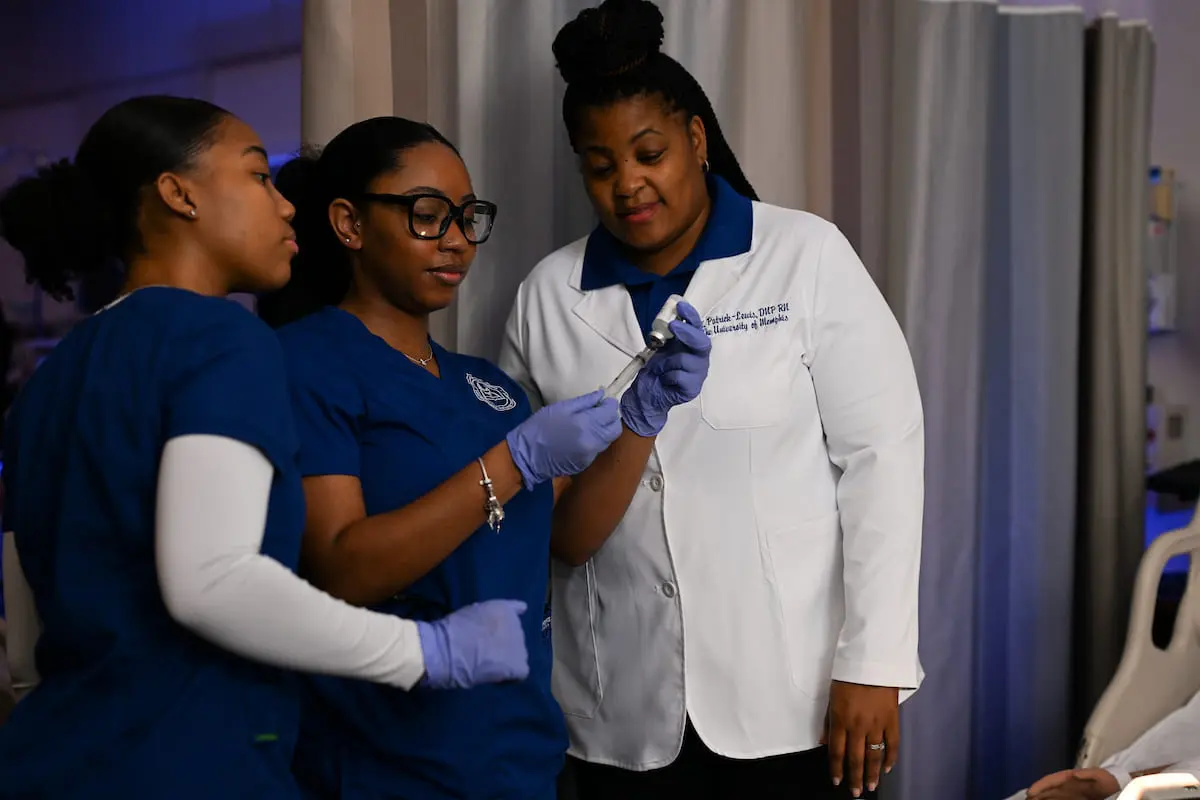
The University of Memphis Loewenberg College of Nursing is being proactive and diligent in addressing the nursing shortage in Tennessee, which is projected to have a scarcity of 8,500 registered nurses by 2035 according to the Tennessee Hospital Association (THA). With the growing population in Tennessee, THA projects that the nursing workforce needs to grow upwards of 25,900 to meet the healthcare needs of Tennesseans.
“The way we are addressing that shortage is by offering programs to meet that need. We run the largest undergraduate program in the state, so we really do take it seriously by providing a high-quality graduate ready to serve as a staff nurse. We work closely with our clinical partners,” said Brad Harrell, DNP, APRN, ACNP-BC, assistant dean for Community Partnerships and Practice and Acting Associate Dean for Academic Affairs.
The college degree programs include the Bachelor of Science in Nursing (BSN), the Accelerated BSN, Traditional BSN, RN to BSN, Master of Science in Nursing, Doctor of Philosophy in Nursing, and the Post-MSN Certificate programs in Memphis and Jackson, Tenn.
Shortage of nurses is among the most cited and issues affecting hospitals today. Entities including the American Association of Colleges of Nursing and the Tennessee Center for Health Workforce Development have identified several factors that need to be addressed to counteract the shortage. Among them is that nursing school enrollment is not growing fast enough to meet the demand of registered nurses due to insufficient clinical sites and classroom space, not enough clinical preceptors, and a shortage of nursing school faculty.
Fortunately for the Loewenberg College of Nursing, their advanced training facilities allow them the capability to admit students who meet the criteria for nursing school versus turning away potential future nurses due to inadequate training facilities and space.
“Thankfully, that is not our issue,” said Dr. Harrell. “You’ve got programs out there where hundreds of students actually meet the criteria, but they just don’t have room to take them into the program. We have the capacity to educate and graduate nurses.”
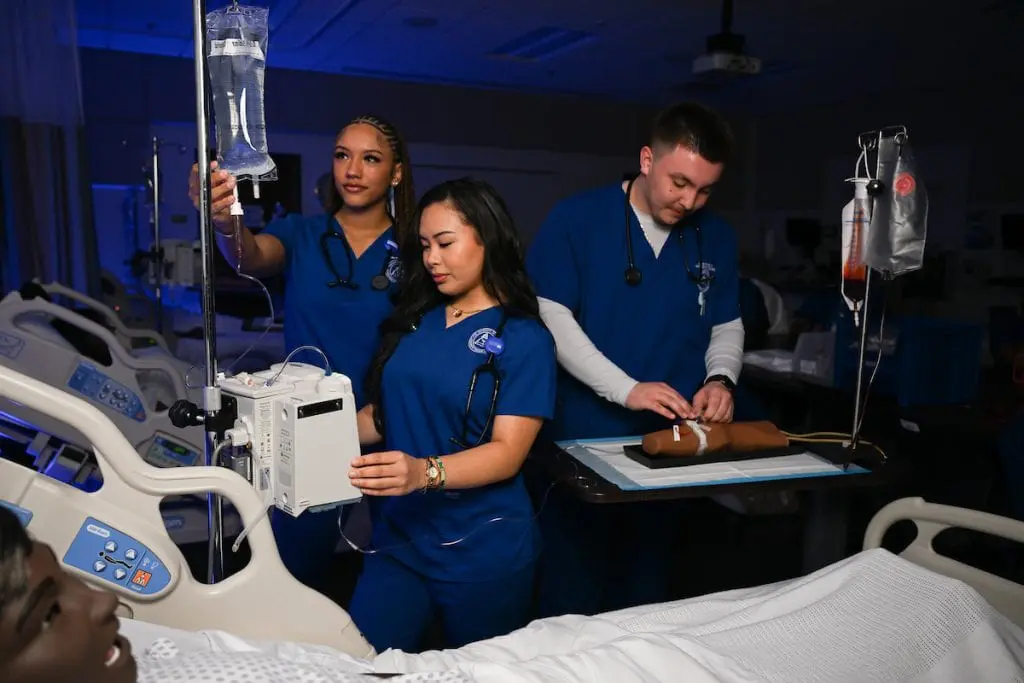
The college’s home is the Community Health Building on UofM’s Park Avenue Campus, a $60 million and nearly 200,000 square foot facility, that boasts eight state-of-the-art simulation rooms with various types of simulation ranging from pediatrics, maternal and obstetrics to community-based simulation. High-fidelity manikins valued at more than $100,000 can simulate speech and even deliver a baby. On the Lambuth Campus, Sprague Hall is equipped with virtual and augmented reality technology that facilitates active student learning with nearly endless clinical scenarios.

The college is also proactive in maintaining its numbers of clinical preceptor partners. Clinical preceptors are vital to training nursing students and without them, students would not get the field training exposure needed to practice. In fact, the college partners with preceptors during the last semester of their undergraduate nursing school curriculum in which students spend 240 hours with a preceptor at a clinic or hospital.
Ensuring a program has access to enough preceptors is essential to degree completion.
Currently, the Loewenberg College of Nursing maintains over 1,000 clinical sites and 1,100 preceptors for its nursing students and is continuously nurturing partnerships in order to grow these numbers. The college is also using grant funding that aims to improve preceptor training and workforce shortages.
The college has been creative in ensuring enough faculty are available on site through utilizing part-time or adjunct faculty. The faculty shortage may be attributed to disparities in salary and pay, which is almost double or triple when working clinically versus in academia.
“The way we are answering that shortage here at the University of Memphis is by having programs that train educators such as our Master of Science in Nursing Education program, this program prepares nursing faculty. So, both that and our PhD program, people can graduate from those two programs and become nurse educators.”
The Loewenberg College of Nursing is also ensuring that their graduates successfully assimilate into the profession through building community among their cohort and health care systems, and have access to resources to aid in mental and physical wellness. “Our students do take on a lot…they see illness, death, all different types of things. Our jobs are to keep University resources readily available for our students if they need it. We make sure they are supported and they have the tools to be self-aware enough that they’re able to function healthily in the profession.”