

[et_pb_section fb_built=”1″ admin_label=”section” _builder_version=”4.27.4″ background_color=”rgba(0,54,130,0.07)” animation_style=”fade” animation_duration=”400ms” custom_css_free_form=”.et_pb_image_0_tb_body{|| display: none !important;||}||||.et_pb_text_3 blockquote {|| background-color: #fff;|| border-left: 5px solid #007BFF; /* Blue accent border */|| margin: 20px 0; /* Spacing around the blockquote */|| padding: 20px; /* Inner padding */|| box-shadow: 0 4px 8px rgba(0, 0, 0, 0.1); /* Subtle shadow for a modern look */|| border-radius: 10px; /* Rounded corners */||}||||.et_pb_text_3 blockquote h1 {|| font-size: 1.5rem; /* Adjust font size */|| color: #333; /* Darker font color for better contrast */|| text-align: center; /* Center-align the text */|| font-family: ‘Georgia’, serif; /* Elegant font choice */|| line-height: 1.4; /* Improve readability */|| margin: 0; /* Remove extra margin */||}||.et_pb_section.et_pb_section_0.et_section_regular {|| padding-top: 0px;||}||.et_pb_row.et_pb_row_1_tb_body {|| padding-top: 0px;||}||ow.et_pb_row_0 {|| padding-top: 0px;||}||||||/* styling tests */||||.et_pb_fullwidth_menu {|| background: #ffffff;|| box-shadow: 0 2px 10px rgba(0,0,0,0.05);||}||||.et_pb_fullwidth_menu ul li a {|| color: #000 !important;|| font-weight: 600;|| transition: color 0.3s ease;||}||||.et_pb_fullwidth_menu ul li a:hover {|| color: #0066cc !important; /* Accent hover color */||}||||.et_pb_fullwidth_menu .et_pb_menu__logo img {|| max-height: 50px;|| transition: transform 0.3s ease;||}||||.et_pb_fullwidth_menu:hover .et_pb_menu__logo img {|| transform: scale(1.03);||}||||||.et_pb_image .et_pb_image_wrap img {|| border-radius: 30px;|| box-shadow: 0 1px 5px rgba(0,0,0,0.08);|| transition: transform 0.3s ease;||}||||.et_pb_image .et_pb_image_wrap img:hover {|| transform: translateY(-3px);||}||||||/* transitions */||a, .et_pb_button, .et_pb_more_button {|| transition: color 0.3s ease, background-color 0.3s ease, transform 0.3s ease;||}||||a:hover {|| color: #0066cc;||}||||/* headings */||.et_pb_heading_container h1,||.et_pb_heading_container h2,||.et_pb_heading_container h3 {|| font-weight: 700;|| text-transform: uppercase;|| letter-spacing: 1px;|| color: #003087 !important;||}||||||||/* background enhances */||||.et_pb_section_0.et_pb_section {|| background-color: #00368212 !important;|| border-radius: 18px;|| background: #fff;|| /* border-radius: 8px; */|| box-shadow: 0 8px 24px rgba(0, 0, 0, 0.15);|| transition: box-shadow 0.3s ease;||}||||.et_pb_section_0.et_pb_section:hover {|| box-shadow: 0 10px 30px rgba(0, 0, 0, 0.2);||}||||.et_pb_row_1_tb_body{ || display: none||}||||.et_pb_row_0_tb_body {|| padding: 0 !important;||}||||.et_pb_row_2_tb_body {|| padding: 0;||}” global_colors_info=”{}”][et_pb_row column_structure=”1_2,1_2″ _builder_version=”4.27.4″ _module_preset=”default” custom_margin=”|auto|-41px|auto||” global_colors_info=”{}”][et_pb_column type=”1_2″ _builder_version=”4.27.4″ _module_preset=”default” global_colors_info=”{}”][et_pb_text _builder_version=”4.27.4″ _module_preset=”default” global_colors_info=”{}”]
Have you ever wondered what makes the stars twinkle in the night sky?
Or why you feel a bump when you’re flying in a plane?
It’s because of turbulence.
One of the reasons fluid dynamics is so important is because of turbulence. Turbulence is not just something we experience when flying in a plane; it’s all around us. It’s the chaotic motion of flows, air and water moving around.
It affects everything we do, from transportation to energy production to imaging over long distances. It also affects how we breathe and interact with other people. Turbulence is an integral part of our everyday lives, and understanding it is crucial to improving various aspects of our world.
That’s where my research comes in.
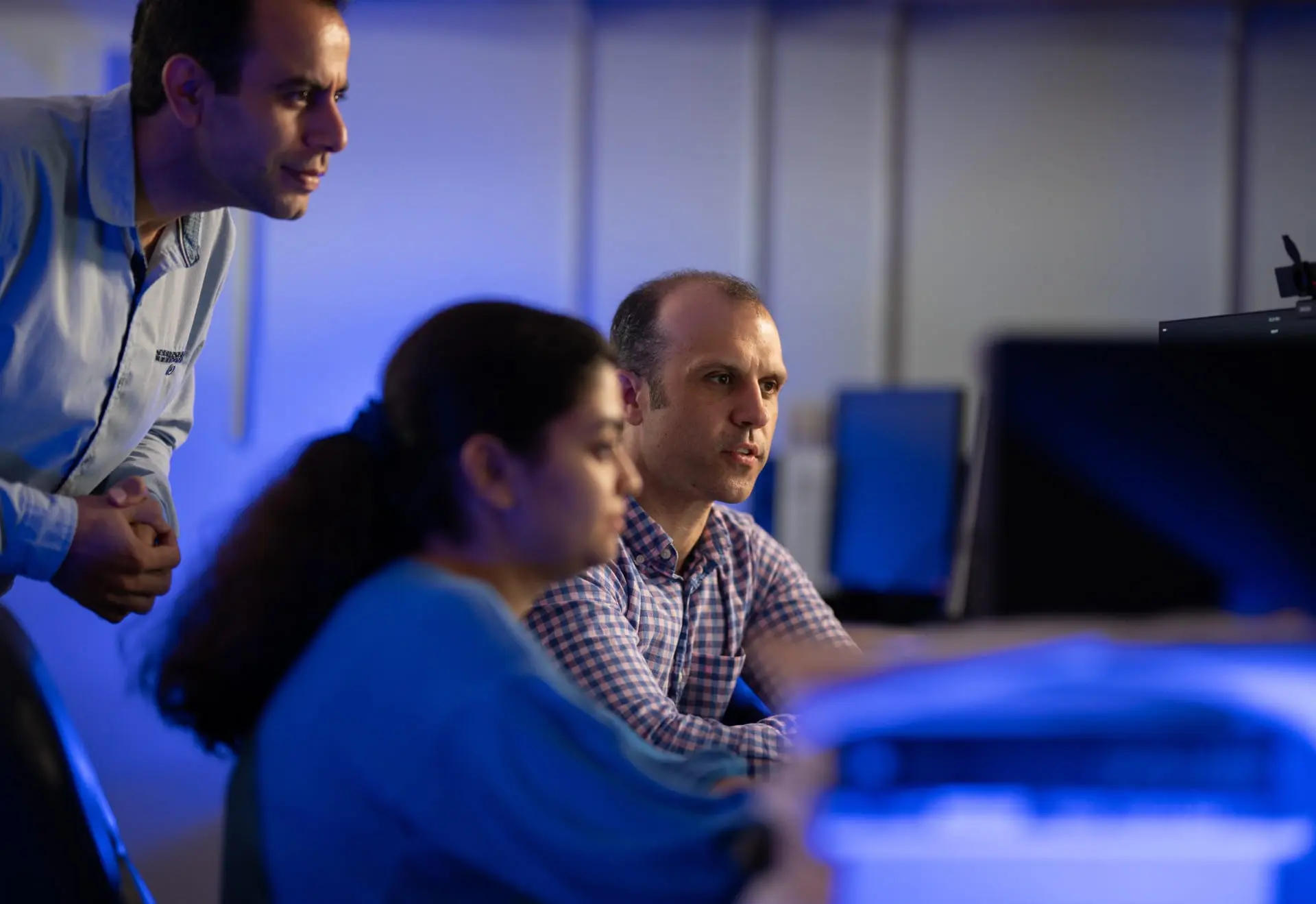
[/et_pb_text][/et_pb_column][et_pb_column type=”1_2″ _builder_version=”4.27.4″ _module_preset=”default” global_colors_info=”{}”][et_pb_image src=”https://news.memphis.edu/wp-content/uploads/2024/12/Daniel-Foti-with-students.jpg” alt=”Professor and graduate students looking at computer monitor.” title_text=”Dr. Daniel Foti with graduate students” align=”center” _builder_version=”4.27.4″ _module_preset=”default” custom_margin=”||||false|false” global_colors_info=”{}”][/et_pb_image][/et_pb_column][/et_pb_row][et_pb_row _builder_version=”4.27.4″ _module_preset=”default” min_height=”195px” custom_margin=”-34px|auto||auto||” custom_padding=”0px||0px|||” global_colors_info=”{}”][et_pb_column type=”4_4″ _builder_version=”4.27.4″ _module_preset=”default” global_colors_info=”{}”][et_pb_text _builder_version=”4.27.4″ _module_preset=”default” width=”94.9%” min_height=”250.4px” custom_margin=”||0px||false|false” custom_padding=”0px||0px||false|false” global_colors_info=”{}”]
My Research Journey
My fascination with fluid dynamics and turbulence began with a love for airplanes and space.
I grew up in Cincinnati, Ohio, and pursued a degree in mechanical engineering at Case Western Reserve. Then, I continued my education and received my master’s at Georgia Tech and, finally, my PhD from the University of Minnesota.
After spending some time at the University of Michigan, I came to the University of Memphis to be an assistant professor and work with mechanical engineering students.
Fluid dynamics is one of the coolest and most complex aspects of classical mechanics. Air, water and other fluids impact us daily, from the wind blowing outside to water running through our pipes. Despite its everyday occurrence, turbulence remains one of the last unsolved physical problems of classical mechanics.
My research is about finding solutions and elucidating details about turbulence through computational methods.
Starting with the highly complex Navier-Stokes equations, we discretize and simulate the flow field, which lead to millions of unknown data points to be solved. For large problems, these can only be solved on large high-performance computers. We use both University of Memphis and federally funded high-performance computers to simulate the flow.
From these simulations, we can decode details about vast problems such as cavitation and atmospheric boundary layers. I can also obtain information about the flows and compare it with experiments to validate the data.
[/et_pb_text][/et_pb_column][/et_pb_row][et_pb_row _builder_version=”4.27.4″ _module_preset=”default” global_colors_info=”{}”][et_pb_column type=”4_4″ _builder_version=”4.27.4″ _module_preset=”default” global_colors_info=”{}”][et_pb_text _builder_version=”4.27.4″ _module_preset=”default” global_colors_info=”{}”][/et_pb_text][/et_pb_column][/et_pb_row][et_pb_row column_structure=”2_5,3_5″ _builder_version=”4.27.4″ _module_preset=”default” min_height=”480.1px” custom_margin=”0px|auto||auto|false|false” custom_padding=”0px||0px|||” global_colors_info=”{}”][et_pb_column type=”2_5″ _builder_version=”4.27.4″ _module_preset=”default” global_colors_info=”{}”][et_pb_image src=”https://news.memphis.edu/wp-content/uploads/2024/12/Daniel-Foti-portrait.jpg” alt=”Man gazes out of window.” title_text=”Dr. Daniel Foti portrait” _builder_version=”4.27.4″ _module_preset=”default” custom_margin=”|0px|||false|false” global_colors_info=”{}”][/et_pb_image][/et_pb_column][et_pb_column type=”3_5″ _builder_version=”4.27.4″ _module_preset=”default” global_colors_info=”{}”][et_pb_text _builder_version=”4.27.4″ _module_preset=”default” width=”100%” min_height=”252px” custom_margin=”|0px|0px|0px|false|false” custom_padding=”|||0px||” global_colors_info=”{}”]
A Renewable Future
One area where my research has significant implications is in energy production, particularly wind energy.
By understanding the fluid mechanics and turbulence behind wind turbines, we can optimize their efficiency and increase power production.
This is especially important as we shift toward renewable energy sources to combat climate change.
[/et_pb_text][et_pb_text _builder_version=”4.27.4″ _module_preset=”default” text_font_size=”11px” header_font_size=”36px” header_letter_spacing=”2px” header_line_height=”1.2em” background_color=”RGBA(255,255,255,0)” max_width=”100%” min_height=”172.8px” custom_margin=”0px|0px||0px|false|false” custom_padding=”0px|0px|0px|0px|false|false” animation_style=”slide” animation_direction=”right” animation_duration=”1850ms” locked=”off” global_colors_info=”{}”]
“My research is about finding solutions and elucidating details about turbulance through computational methods.”
[/et_pb_text][/et_pb_column][/et_pb_row][et_pb_row _builder_version=”4.27.4″ _module_preset=”default” custom_margin=”-37px|auto||auto||” global_colors_info=”{}”][et_pb_column type=”4_4″ _builder_version=”4.27.4″ _module_preset=”default” global_colors_info=”{}”][et_pb_text _builder_version=”4.27.4″ _module_preset=”default” custom_padding=”0px||||false|false” global_colors_info=”{}”]
Support Systems
I’m fortunate to have incredible partnerships both within and beyond the University for my research.
At the University, I work with material scientists, mechanical engineers and experts in energy optimization. Outside the University, I have partnerships with the Navy, Army, and national laboratories focusing on various aspects and applications of fluid dynamics and turbulence. These partnerships allow me to collaborate with experts in different fields and tackle a wide range of research topics.
I’m also grateful to work with many students in the lab.
They bring a fresh perspective and ask questions that challenge me to think in different ways. Seeing them learn and dive into complex topics like high-performance computing is incredibly exciting.
Overall, my research in fluid dynamics and turbulence is aimed at solving the unknown and improving various aspects of our world. From energy production to transportation to imaging, understanding these complex processes has the potential to make significant advancements in our everyday lives.
And through these partnerships and the support of our students, I’m able to continue exploring those processes.
[/et_pb_text][/et_pb_column][/et_pb_row][et_pb_row _builder_version=”4.27.4″ _module_preset=”default” global_colors_info=”{}”][et_pb_column type=”4_4″ _builder_version=”4.27.4″ _module_preset=”default” global_colors_info=”{}”][et_pb_text _builder_version=”4.27.4″ _module_preset=”default” global_colors_info=”{}”]Research in a Minute is part of a series from the University of Memphis showcasing the innovative research being done by our faculty.
Watch Dr. Daniel Foti’s Research in a Minute video below.
[/et_pb_text][/et_pb_column][/et_pb_row][et_pb_row _builder_version=”4.27.4″ _module_preset=”default” global_colors_info=”{}”][et_pb_column type=”4_4″ _builder_version=”4.27.4″ _module_preset=”default” global_colors_info=”{}”][et_pb_video src=”https://www.youtube.com/watch?v=QvLcNb2qqAo” _builder_version=”4.27.4″ _module_preset=”default” global_colors_info=”{}”][/et_pb_video][/et_pb_column][/et_pb_row][/et_pb_section]