

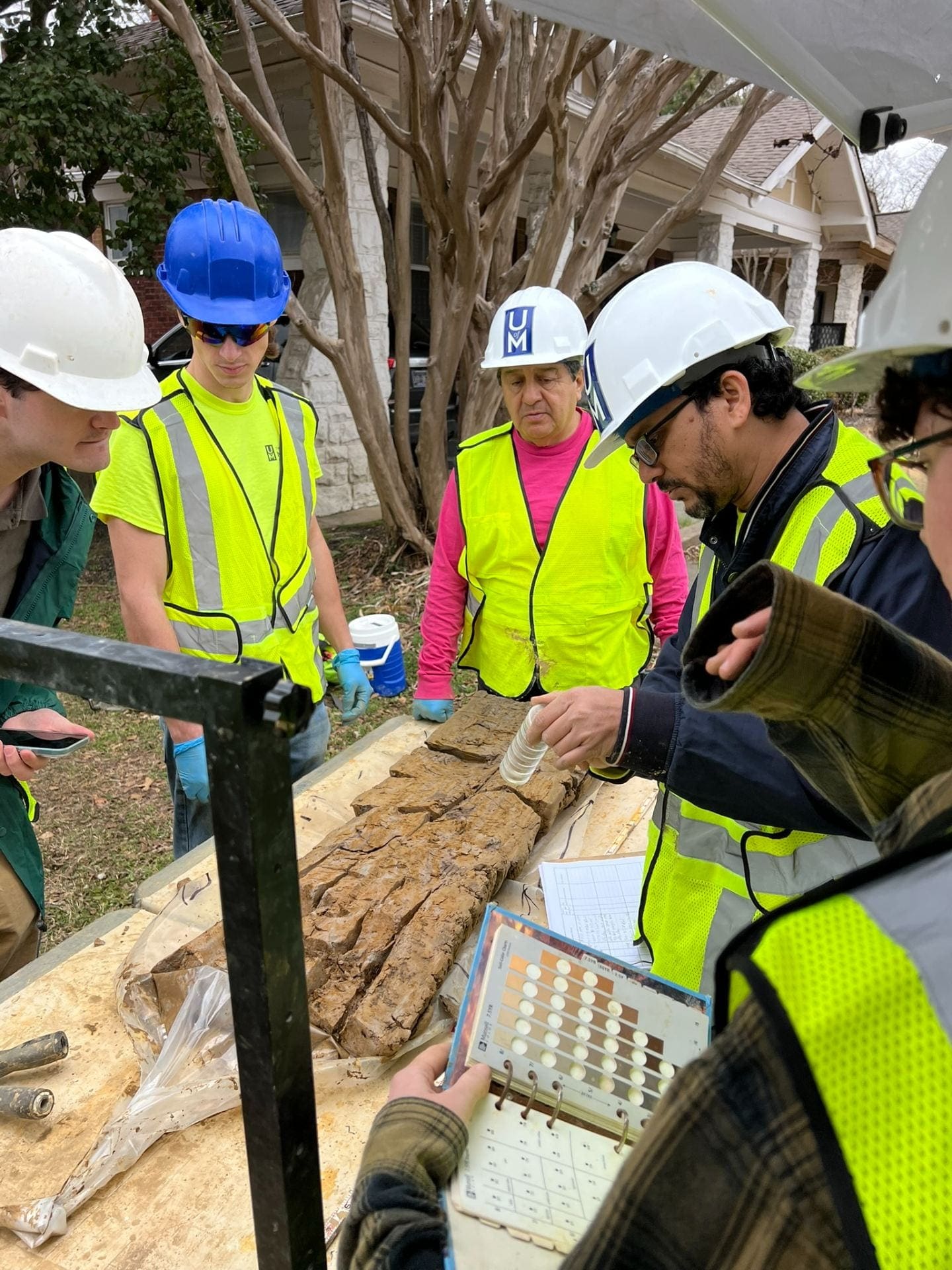
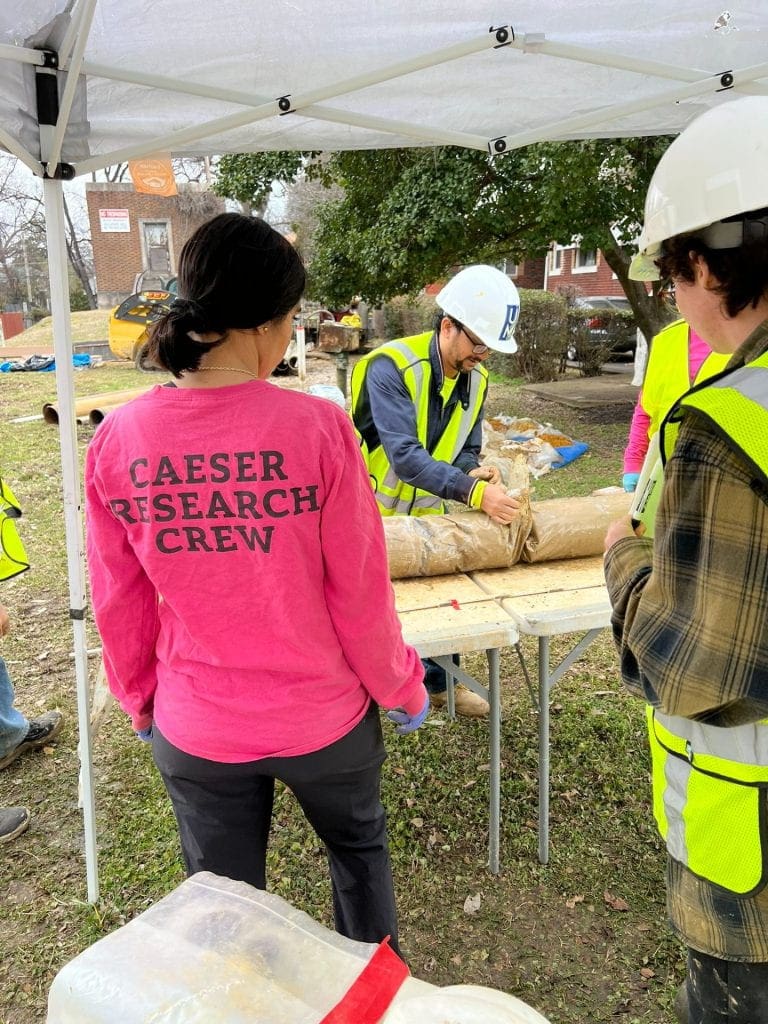
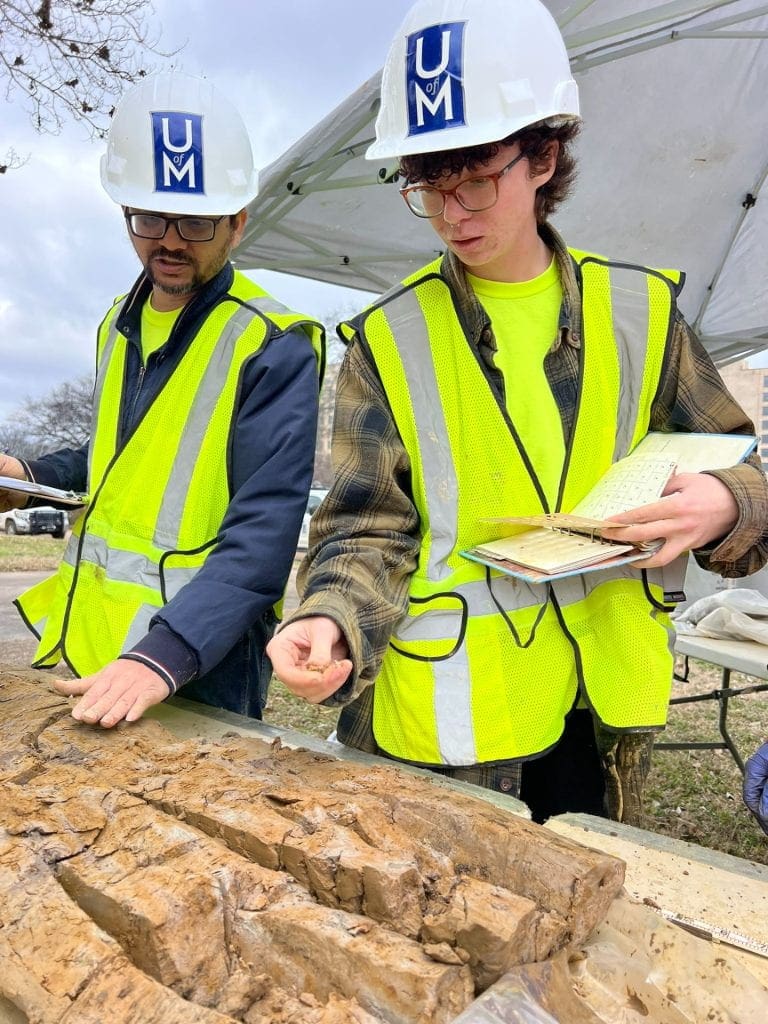
MEMPHIS/SHELBY COUNTY, Tenn. — Behind Crosstown Concourse near Downtown Memphis, the Center for Applied Earth Science and Engineering Research (CAESER) was hard at work drilling into the Memphis Aquifer. Led by Logistics Coordinator Saddam Hossain and PhD student Ivan Zamora-Plaza, the team was investigating potential weak points and breaches in the aquifer as part of a five year, nearly $10 million project examining legacy pollution entering the system.
“The overall objective is to study vertical water movement and travel time from the surface through the vadose zone, into the shallow aquifer system, and then into the Memphis Aquifer through breaches,” Zamora-Plaza said. “This will help us to improve what we know and improve our models, estimations, decisions, etc.” Zamora-Plaza said.
The drilling location behind Crosstown Concourse, known as the Mallory Wellfield site, offers ideal conditions for monitoring aquifer behavior, according to Zamora-Plaza. With a relatively shallow water table and a clear contrast of soil layers, the site allows researchers to track how water moves downward through the ground and into the shallow aquifer. CAESER drilled 50 feet into the ground to monitor these characteristics.
“This allows us to examine how water moves through contrasting materials and under conditions where part of the upper profile behaves more like a shallow saturated zone,” Zamora-Plaza explained. “From my perspective, this site will help us better understand travel times and the age of water that eventually reaches the Memphis Aquifer. Improving those estimates allows us to refine our models and support better preventive decision making in the future.”
The work at Mallory Wellfield is part of a long-term effort to better understand and protect the Memphis Aquifer, one of the region’s most valuable natural resources. In 2018, Memphis Light, Gas and Water (MLGW) funded a five-year, $5 million CAESER study after concerns emerged about the condition of the clay confining layer, or aquitard, that protects the aquifer.
That research significantly expanded the known and suspected number of breaches, revealing that the protective clay layer is far less continuous than once believed. Early estimates of two known breaches and six suspected breaches grew to six known and 36 suspected. Current research suggests the true number in Shelby County may be between 70 and 100.
Recognizing the importance of staying ahead of potential risks, the City of Memphis — through the Tennessee Department of Environment and Conservation — and MLGW awarded CAESER a new five-year, $9.75 million contract in 2023. This phase focuses on developing new technology for detecting breaches in urban areas, advancing computer models that simulate water and contaminant movement, and providing local agencies with science based guidance for planning and development decisions. Lucinda Scrivener, CAESER’s Education and Outreach coordinator, said the work reflects the center’s mission to turn scientific discovery into practical solutions for communities.
“When we study the Memphis Aquifer, we’re not just looking at the water underground. We’re looking at the entire system that influences it,” she said. “Understanding how water moves from the surface, through the vadose zone, and into the shallow aquifer is essential if we want to protect the deeper Memphis Aquifer for generations to come.”
Scrivener and Zamora-Plaza have both referred to “the vadose zone.” This is the layer that goes from just beneath the surface to the phreatic zone, or a saturated water zone. The vadose zone contains soil, air, water and living things, such as plant roots, insects and animals. Because water is more affected by gravity and atmospheric pressure in the vadose zone, water moves downward. Scrivener added that the Mallory Wellfield site, along with others across Shelby County, will help refine models and deepen understanding of how legacy pollution can move through breaches.
“Our goal is to translate research into real-world impact,” she said. “That means anticipating challenges, informing decisions, and helping build a resilient, sustainable future for our community.”
For Zamora-Plaza, work at the Mallory site represents more than data collection. It’s the intersection of scientific discovery, community responsibility, and personal purpose. The partnership between CAESER, MLGW and the City of Memphis gives him a front row seat to how research can directly shape public decisions, strengthen infrastructure and safeguard future generations. It’s the kind of work that reminds him why he chose this field in the first place.
“For me, projects like this make science tangible,” he said. “It’s one thing to study groundwater in theory, but it’s another to be out in the field collecting data that directly relates to the water people depend on. I really value that this work is connected to the community. Partnerships like the one with MLGW show how a city, a public utility and a University can work together in a meaningful way. That kind of collaboration represents doing things the right way, using science to inform better decisions that actually matter.”