

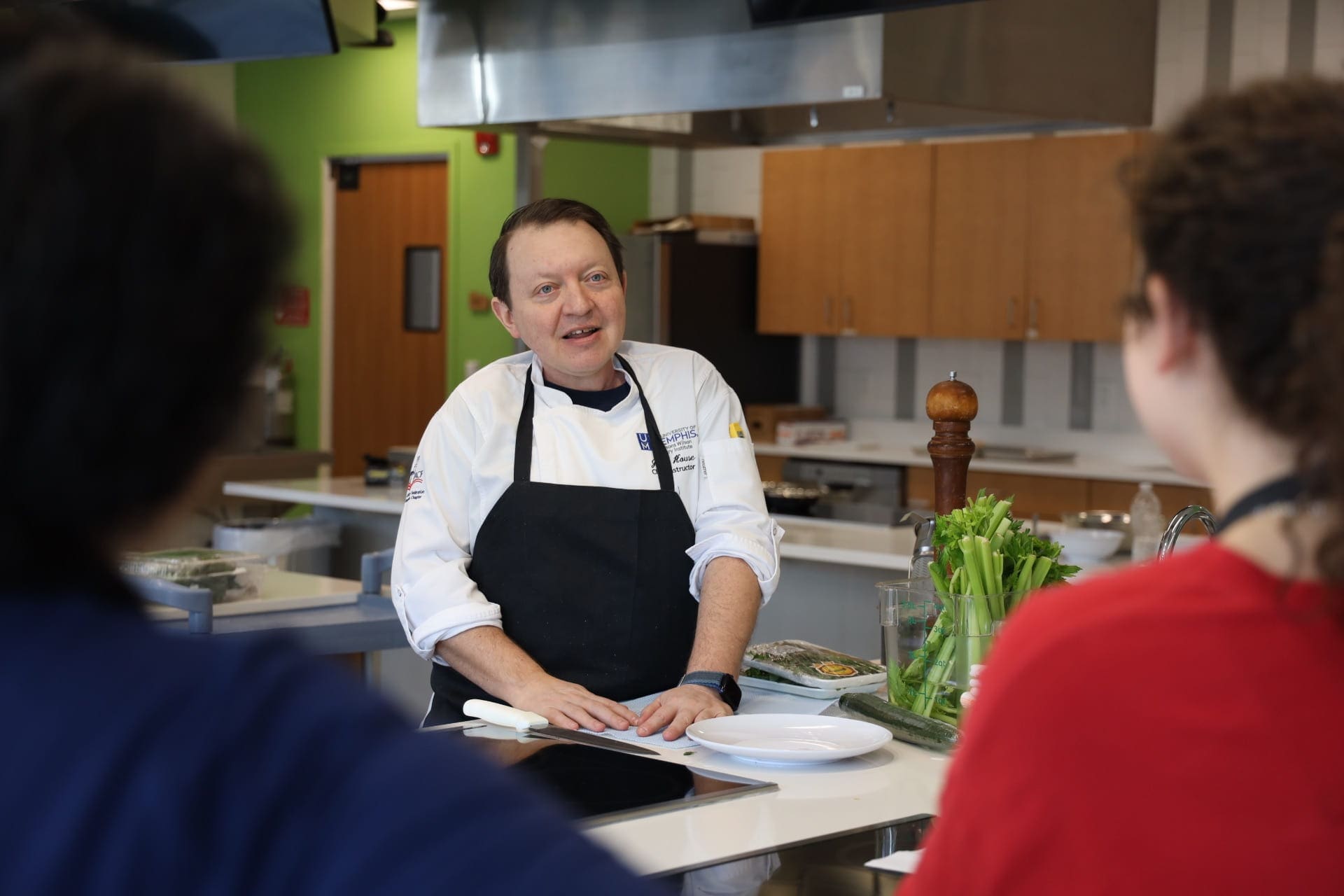
When Chef Eric Etter embarked on his health journey, he wanted to implement something that he could easily manage, monitor and incorporate into his daily life.
It was through food that he found his medicine.
He knew exactly who could help, friend and colleague Chef Joshua House, who had been teaching a culinary medicine course at Church Health piloted and established by Pathologist Susan Warner, MD, for medical residents.
House, assistant professor of teaching in the Kemmons Wilson School of Hospitality and Resort Management (KWS), is a Certified Culinary Medicine Professional, a certification that provides chefs and foodservice professionals with the culinary skills to effectively combine nutritional knowledge and health into options for menus and clientele.
“I think this method of taking control of your health through food is trending because people are realizing that preventive medicine matters,” said Etter, KWS assistant professor of teaching. “We’ve seen an increase in chronic diseases like diabetes, hypertension, heart disease, obesity…and they are all affecting people at a much younger age. Many people want to feel like they have control over their own health, and food is something that we interact with multiple times a day, so it becomes the most practical ways to make a change within our own health.”
After following a Mediterranean diet which inspires many of the recipes and techniques that culinary medicine follows, Etter noticed immediate health benefits. Today he is not only healthier but also a Certified Culinary Medicine Professional himself.
The duo is now teaching the Culinary Medicine Course to University of Tennessee Health Science Center medical students and residents in partnership with Le Bonheur Pediatrician and UTHSC Assistant Professor, Dr. Rana Assfoura.
“Our goal at the culinary medicine program is to show that healthy food can be simple, delicious and budget-friendly. We hope that educating medical and culinary professionals will be the way to reach as many families as possible in an effort to empower our community to live healthier,” Assfoura said.
“This is the most requested elective for medical students,” said House.
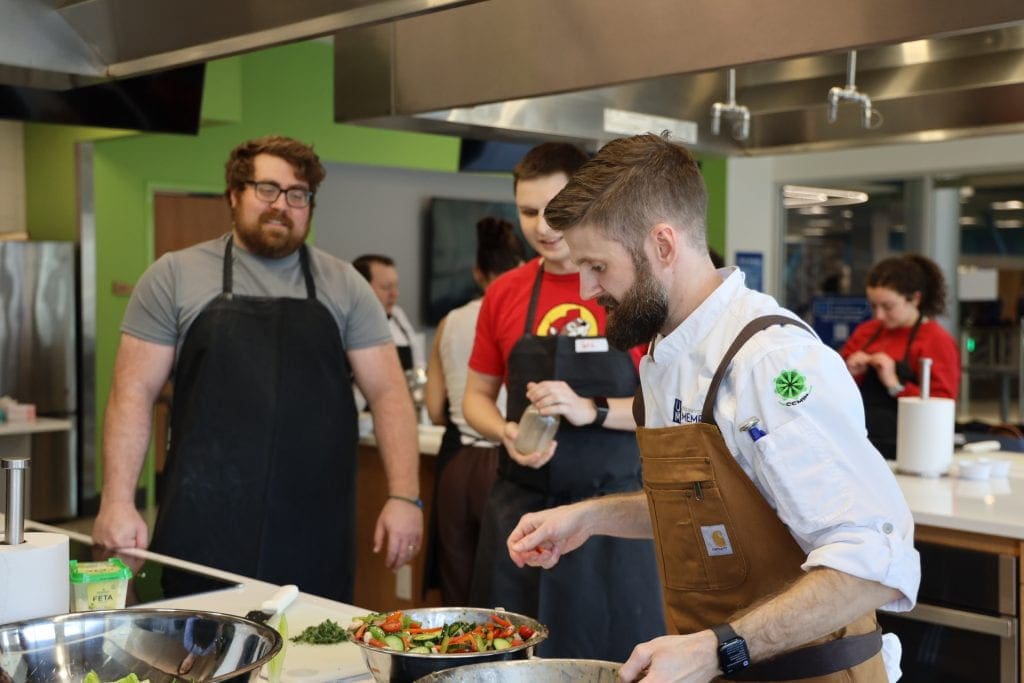
The class ranges in size from 16-24 students. And because of its popularity, they hope to be able to expand the program to pre-health undergraduate students through a new course offered by the College of Health Sciences.
“I believe the elective is getting popularity due to the increased awareness of the effect of nutrition on chronic disease prevention and management, thus emphasizing the need to provide medical professionals with proper nutrition education,” Assfoura said.
The class is taught in the Tiger Food lab — a cooking space equipped with 12 cooking stations, an instructor’s station with overhead cameras, and lecture and dining seating for up to 24 people — in the R. Brad Martin Student Wellness Center. “My experience working with UofM chefs and administration staff has been nothing but positive. Chefs Joshua and Eric have been very knowledgeable and supportive. The new kitchen not only provides access to higher level of technology but also a more elegant and modern setting,” Assfoura said.
“I’m so proud that we have something like this at the University of Memphis that the community is using and the Tiger Food lab works very well for this class because it’s not a commercial space. We are in a space that resembles your home kitchen and home cooking,” House said. “So, to be able to convey that individuals can do this at home, works really well in that space. And just to be able to look out the glass and see students and people working out and exercising, the whole fitness and health journey is three dimensional and you can see it all in this space.”