

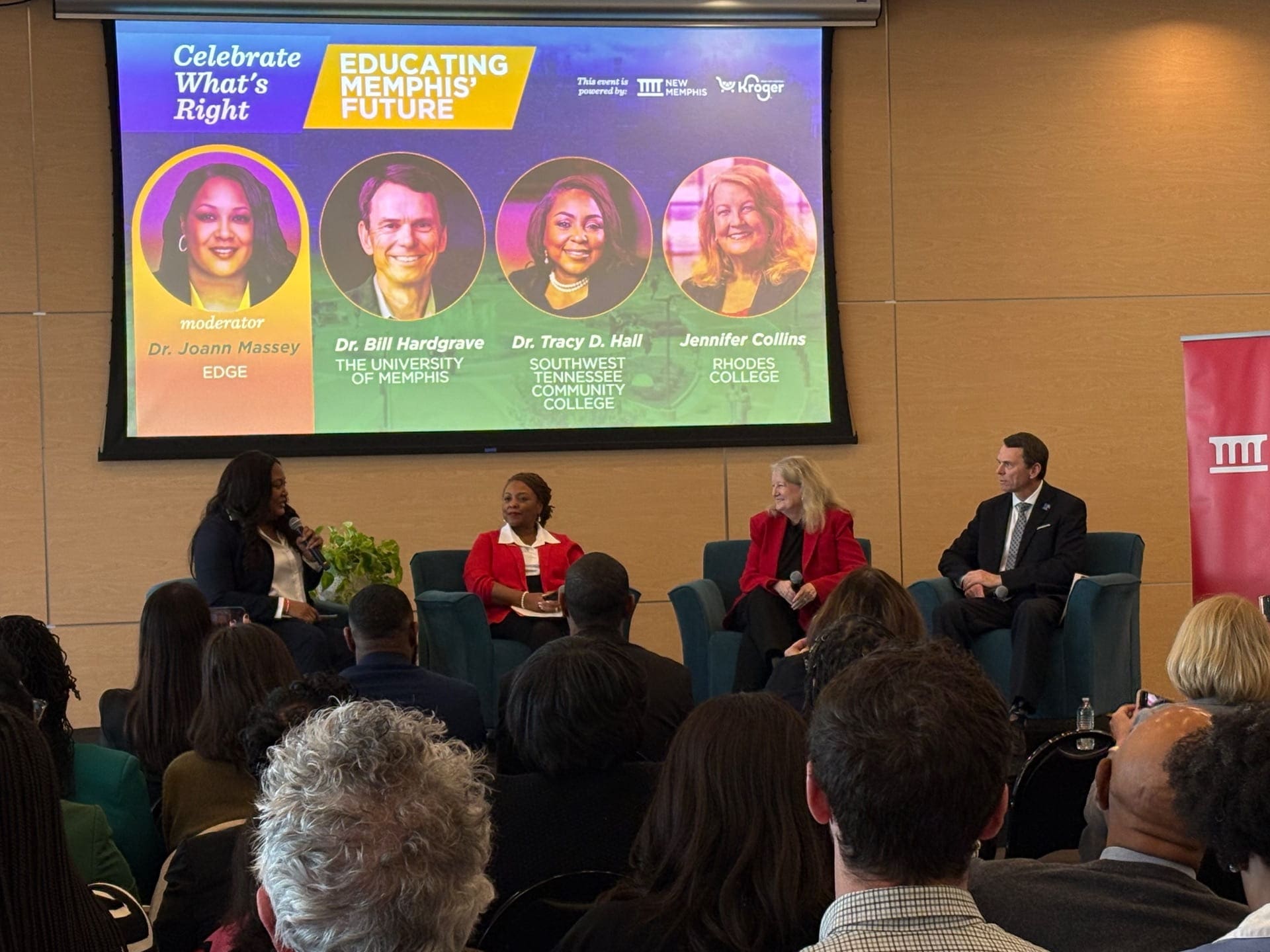
University of Memphis President Dr. Bill Hardgrave was among the panelists invited to a discussion titled “Celebrate What’s Right: Educating Memphis’ Future,” presented by New Memphis on Feb. 24 at the National Civil Rights Museum.
Other area university presidents included Rhodes College President Jennifer Collins, JD, and Southwest Tennessee Community College (STCC) President Dr. Tracy D. Hall.
Their conversations revolved around the impact colleges and universities have in the city’s economy, workforce and talent development, enhancing neighborhood stability and advancing innovation and scholarly research.
“We have something that drives us at the University of Memphis… a commitment to a successful outcome for every student,” Hardgrave said. “That is our commitment and that changes how we view the programs that we offer all the way to the students that we let in.”
Hardgrave shared with the audience that he’s a first-generation college student who’s serving as president of an institution with 52% of its students who are also first-generation. “Without a college education, I wouldn’t be where I’m at today. I’m living proof that there’s value in higher education.”
Dr. Joann Massey, president and CEO at EDGE (the Economic Development Growth Engine for Memphis and Shelby County) moderated the panel discussion, emphasizing the important role colleges and universities have in building the talent ecosystem for Memphis.
“People come here for our assets, our resources, our geographic location, for our technology, our innovation, but our people are our most valuable asset and why companies come here,” Massey said. “It’s not just about landing the deals. It’s about building a talent ecosystem. So, when a student earns a degree, this is the type of talent that we want to keep here in Memphis.”
Hardgrave highlighted the UofM’s latest economic report, which showed that in 2024 the University generated nearly $1B ($998M) in economic impact, including $547M in direct operating costs and $451M in wages. And that more than two-thirds of its graduates remain in the Memphis metro a decade after graduation. Statewide, 74.4% of the UofM’s 2024 graduating class chose to stay in Tennessee.
“I have visited with CEOs of all major companies in the area and every CEO has said they’ll hire our graduates in those fields. That mean’s something to us,” Hardgrave said. “We have to fight hard to make sure that we keep them right here, which means we need to offer programs that lead to good outcomes, and we need our companies to continue to provide those internship opportunities and to hire those graduates when they do finish.”
Being more agile and flexible is something Hardgrave noted that higher education institutions could improve upon.
“We’ve been out of sync; we weren’t built to be reflective or fit the needs of industry in a timely manner,” Hardgrave said. “We have to be better than that. That comes with programs that allow flexibility for somebody to come and take 12 hours, get a certificate and come back out if they need to, or have a major or program of study that directly applies to current workforce needs.”
He highlighted the new Polytechnic@UofM, which is doing just that — redefining applied education by offering flexible, workforce-aligned degree pathways.
Maintaining strong partnerships among educational institutions in the city has also allowed students to be successful through programs like One Step Closer: a program that provides a structured, supportive bridge that leads to gaining admission to the UofM in which UofM partners with SWTC.
“This is a perfect partnership because we can work with students to get them ready, it may just be a couple of classes or wrap-around support. You’d be surprised to hear the number of students that there’s so many things that happened in their life that education or their academics and GPA just have suffered because of life,” Hall said.
“What we’re doing is trying to create an educational ecosystem,” Hardgrave said.
“Powering progress through partnerships,” Massey said. A mantra at EDGE.
The discussion was recorded as the first live audience recording for the New Memphis “Meanwhile in Memphis” podcast which are available each Tuesday and broadcast on WYXR (91.7 FM) radio.