

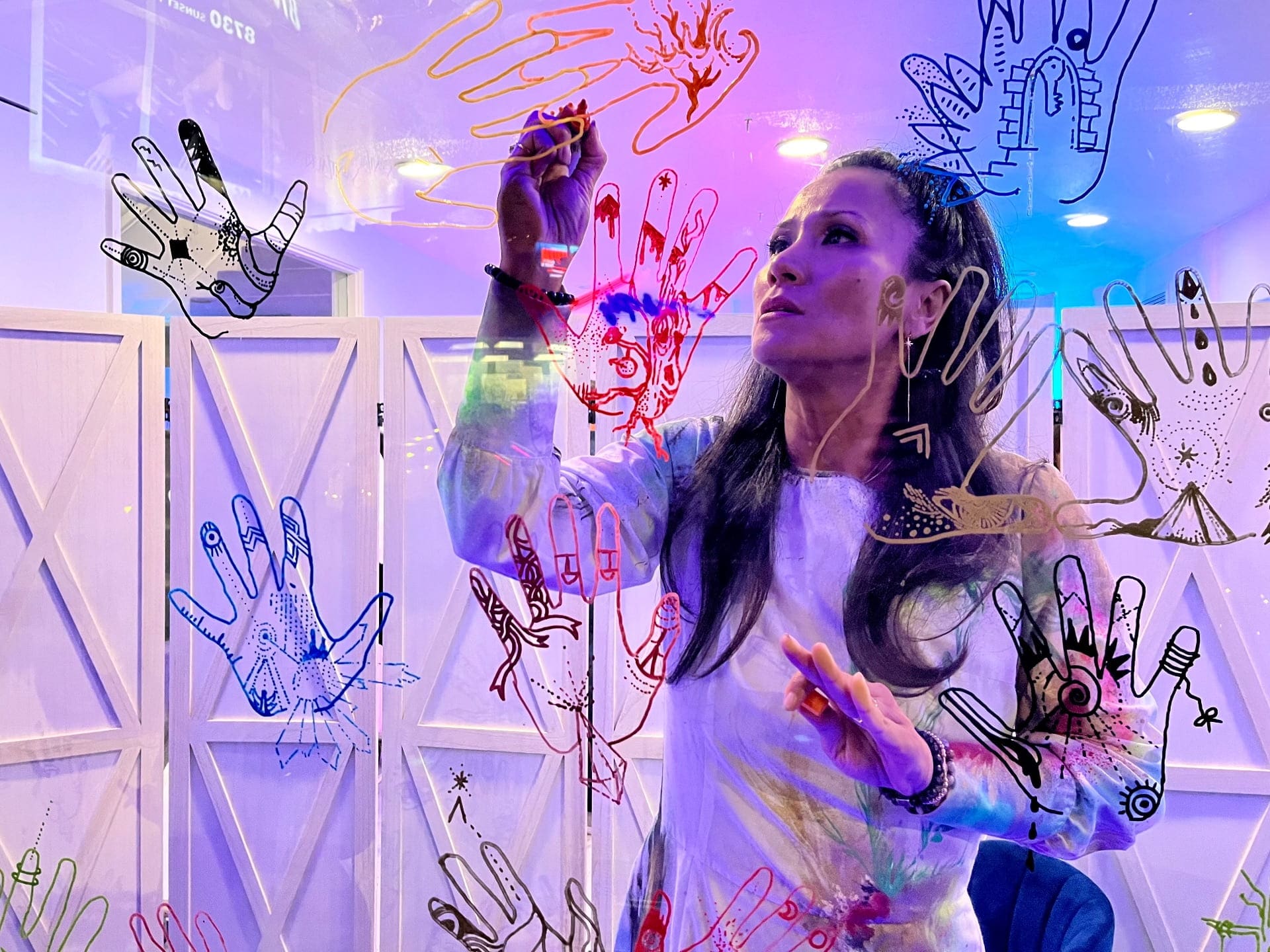
How UofM alumna Sheila Darcey is reshaping healing through art, compassion and community.
On a blank sheet of paper, a single mark appears. Then another. Lines gather, loosen, stretch and fold back into themselves. There is nothing polished or planned about them. They are simply an honest, unfiltered pulse of emotion making its way into the world. It is in this space, in the quiet rhythm of sketching, that Sheila Darcey (’97) first began to find her way back to herself.
Today, Darcey is an internationally recognized artist, facilitator and founder of Living Canvas Foundation, a nonprofit dedicated to helping people of all ages heal through creativity. Her work did not begin as a polished practice, but as survival.
Darcey’s story spans continents. She was born in the Philippines, raised in Australia and eventually found her way to Memphis as a teenager. Those early years were marked by upheaval and a deep sense of instability.
“Pretty much my entire life I’ve had traumatic or challenging experiences,” she shared. “But as a kid, I remembered that I used to draw to disconnect. What I thought I was disconnected from was myself. But knowing now in reflection, I was connecting to myself.”
At the University of Memphis, she initially declared a computer science major. The expectation to have a traditional career weighed heavily on her. It came to a head one day while walking across campus; she saw other students carrying art boxes full of paints and supplies and felt something ache inside her. It was, she said, “like the ghost of me walking by.”
In one of her earliest brave decisions, she told her mother she wanted to switch her major to art. “I thought she was going to kill me,” Darcey laughed softly, recalling the moment. But her mother surprised her with a simple, grounding sentence: If that’s what makes you happy.
Darcey completed her BFA in graphic design and worked seven days a week throughout college to support herself. After graduation, she entered the corporate world under the expectation of stability and success. Years later, she would pay a steep price for that detour.
Twenty years into a career in digital strategy and executive leadership, Darcey hit a breaking point.
“I was completely burnt out mentally, emotionally, physically,” she said. She had not yet learned the language to describe anxiety and depression or the years of unprocessed experience she carried. What she believed was simple exhaustion, revealed itself in therapy to be a full mental health crisis.
Darcey learned that she needed a way to express the things she had never allowed herself to feel. Her therapist asked if she had “a healthy way to express” these pent-up feelings.
She remembered sketching as a child. “I remember walking out of that first therapy session and I went, that’s it.”
She began sketching every morning before work.
Not to make art, but just to let things out.
“It was genuinely to get it out of me,” she said. “And I remember six weeks into it… I thought, oh my God, I must help people find their way to this tool.”
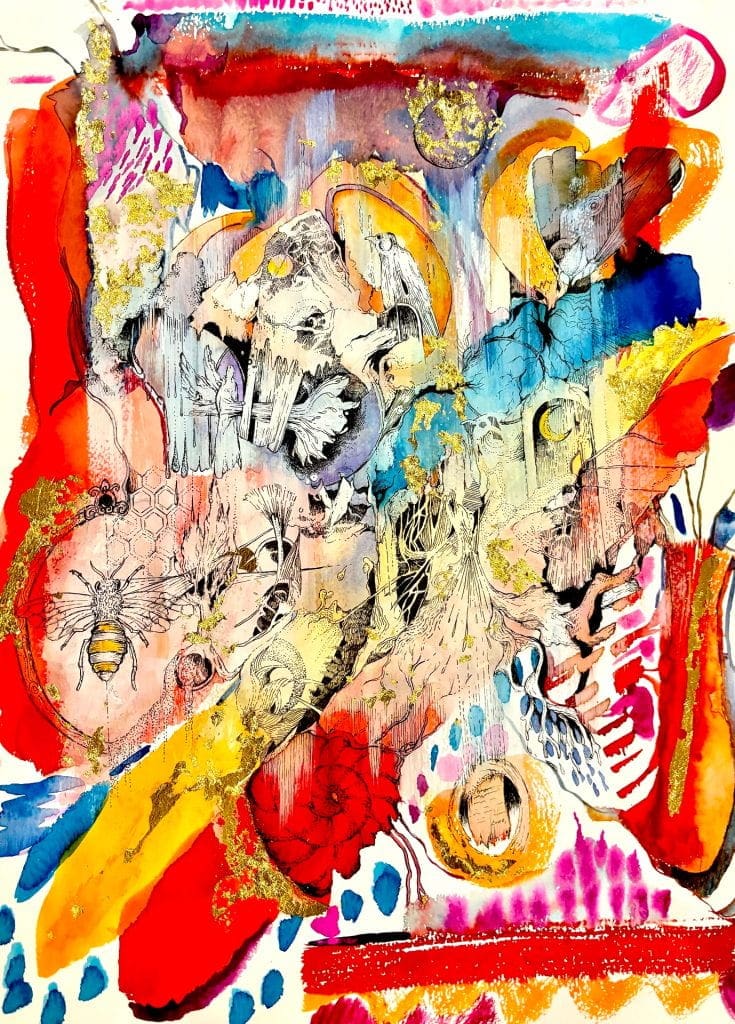
Her daily practice would grow into SketchPoetic, an online community and movement centered around creativity. Later, she would gather these sketches and experiences into a book, “Sketch by Sketch – A Creative Path to Emotional Healing & Transformation.” It became her foundation for leading workshops around the world. Eventually, it would grow into her nonprofit, Living Canvas Foundation.
The turning point came when Darcey realized how many others were seeking what she had sought. People who wanted to create but felt intimidated, people who longed for transformation but didn’t have the tools or language for it and people who believed in their core that creativity was indulgent rather than necessary.
“I’ve always offered to do my work for free,” Darcey explained. “But there are so many people like me out there… and they’re trying to do it for a living. They say, Sheila, it’s so hard. I hate the business of this. I just want to offer it. And it pained me to hear because I get it.”
Living Canvas was born to support two groups: those who offer healing through art and those who have never believed art could heal them .
“There’s this perception of art that it’s a privilege, that it’s an extracurricular thing you do,” she said. “But it is vital. It is vital to our well-being to tap into our creativity because it involves play, it involves imagination and it involves curiosity.”
Her workshops guide participants through breathwork, mark-making, visualization and reflection. They are gentle and structured, grounding creativity in both emotion and neuroscience. And at the heart of it is connection, both to others and to oneself.
“Healing is not about fixing,” Darcey says. “We’re not broken. It’s about remembering and listening and reconnecting to a part of ourselves that we may have suppressed.”
Darcey’s approach is rooted in lived experience, and her reflections are both disarming and profoundly human. Her work with youth, with caregivers, with people facing trauma or transition, all stems from the truth that everyone deserves a place to feel safe within themselves.
“Why I do what I do is because I never felt safe. Ever,” she shared. “Until the day I started picking up that pen… it was the most healing thing.”
In her workshops, she uses the phrase “inner children,” explaining that each moment of disconnection throughout life creates another version of ourselves in need of compassion. Her teachings encourage people to approach themselves with softness rather than self-judgment.
And when she looks at her own life, she sees the throughline she once missed.
“What feels uniquely personal is actually quite universal,” she said. “Your lived experience is not a liability. If anything, it’s your superpower.”
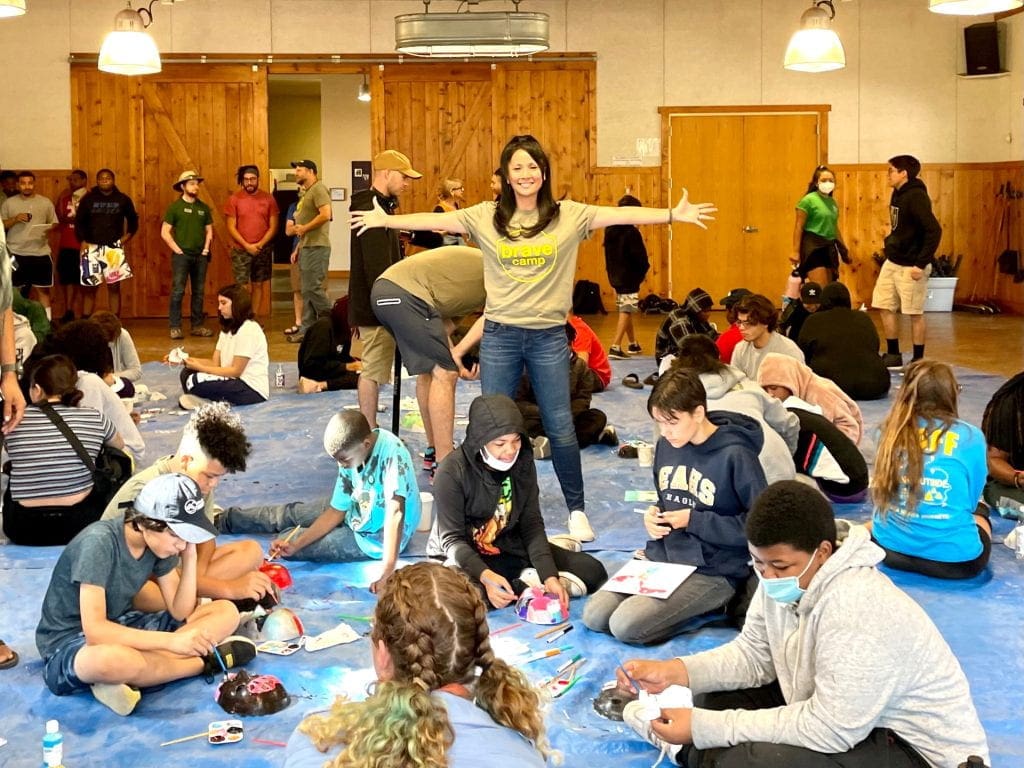
Though Darcey has lived in Los Angeles for many years, Memphis remains a formative chapter in her story. It is where she found her artistic voice, where she confronted parts of herself for the first time and where she began shaping the vision that would guide her life’s work. She sees a hopeful future for the city’s artistic and emotional landscape.
“The future of Memphis… looks more like reciprocity, community, co-creation, collaboration,” she said. “Memphis is the heart of the arts. It is everything that the arts are about —community.”
Her partnership with Dr. Michael Schmidt, associate dean of research at the University of Memphis College of Communication and Fine Arts, on emerging studies for the power of creativityreflects her continued connection to the University and her belief in supporting future generations of creators.
She also highlights individuals in the Memphis community to carry on the vision. Aaron Williams runs the Living Canvas social media and also practices healing through embodied creativity locally.
Stories like Darcey’s illuminate an often-overlooked truth.
The arts are not a luxury, but a lifeline.
At the University of Memphis, creative disciplines give students the space to discover their voice, confront their experiences and develop the empathy needed to build stronger communities. When alumni like Darcey carry that work forward, they extend the University’s impact into new places: classrooms, correctional facilities, community centers and beyond.
By supporting the arts at the University of Memphis, donors and alumni help cultivate that transformation. They make room for students who will become innovators, healers and storytellers. They help sustain the kind of work that reminds people everywhere that creativity is not ornamental — it is essential for a thriving, happy community.
When asked what she would tell a young graduate stepping into the world unsure of who they are or what comes next, Sheila offered this: “You don’t have to choose one identity. Your lived experience is not a liability… and what feels deeply personal is often really universal.”
And perhaps the most powerful reminder of all: “The thing that regulates you might become the thing that serves the world.”
In Darcey’s hands, that truth has already become a reality. In sharing it, she is helping others find the courage to reconnect with the parts of themselves capable of healing and with the lives of those around them.