

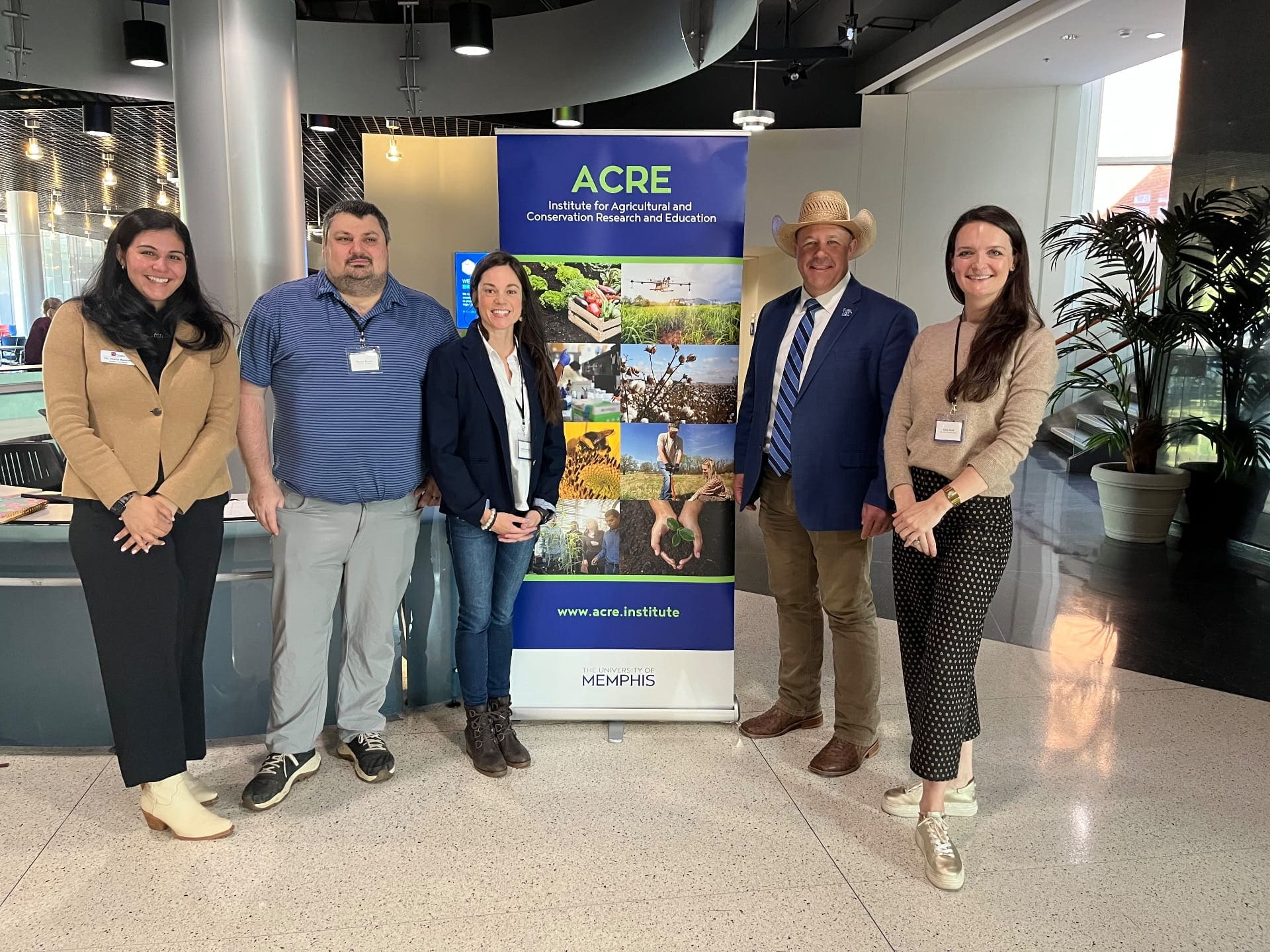
Wood is having a moment. To broaden the understanding of mass timber’s benefits, the University of Memphis Institute for Agricultural and Conservation Research and Education (ACRE) and the Division of Research and Innovation, in partnership with the Tennessee Department of Agriculture hosted Timber Talks April 6-7.
The two-day conference was attended by university faculty, researchers and agriculture leaders from across Tennessee and the U.S. and addressed the status of Tennessee’s forestry and lumber industry, one of the largest drivers of the state’s economy.
“We hosted this convening symposium to educate a wide range of people on the benefits of building with an innovative new material system called mass timber,” said Katie Hunt, AIA, assistant professor in the Department of Architecture. Opening the symposium with a quote she heard from architect Kengo Kuma: “Wood is warm, intimate and connects people. It is the definition of a place‑based material. Wood is community.”
Tennessee Commissioner of Agriculture Andy Holt delivered the general address. “Forest products and wood fiber have long played an important role in our culture and throughout history,” Holt said. “Many of history’s great achievements would not have been possible without wood fiber.”
The symposium was the formal kickoff of the Tennessee Timberworks Collaborative — a Memphis‑led, regional research collective with a shared vision: to study mass timber from forest to building (and beyond), from silviculture and supply chains to design, engineering, construction, policy and community impact.
“While this effort is rooted here in Memphis and in Tennessee, we are intentionally outward‑looking,” Hunt said. “We hope to collaborate deeply with other states and regions also studying the timber industry, because the opportunities and challenges of mass timber do not stop at state lines.”
Memphis is known as the “hardwood capital of the world,” and participants had the opportunity to tour the National Hardwood Lumber Association to further lean about hardwood supply chain, production and distribution as well as the new Memphis Art Museum, an active construction site to see how wood is being utilized in its architectural design.
Throughout the sessions, myths were dispelled regarding misconceptions about wood and the forestry industry, including that the timber industry is bad for the environment and that wood is inferior to concrete or steel. “In fact, it is imperative for our forests’ ecological health and critical to sustainable economies that we have markets for timber,” said Hunt. “In addition, wood structures are actually safer than the others under fire because the burning process naturally creates a protective char layer that limits structural failure of the wood. According to the building codes, mass timber performs so well in fire that it is technically considered non-combustible.”
Other statistics for the state of Tennessee include:
- More than half of Tennessee is forested land (14 million acres)
- More than 80% of those forests are privately owned, primarily by family and non-corporate landowners
- The forest products industry contributes $21 billion annually to the Tennessee economy
- An estimated 85,000 jobs statewide are from the forest products industry
- Tennessee is one of the top ten U.S. states for forestry’s share of GDP (gross domestic product) and number three for hardwood-producing states
- Tennessee grows 1.6 times more wood annually than is harvested
- Less than 1% of standing wood volume is removed each year
“ACRE was proud to host the Timber Talks Conference at the University of Memphis and grateful to the Tennessee Department of Agriculture for supporting this event,” said Dr. Jennifer Mandel, ACRE director and William B. “Billy” Dunavant Endowed Chair, Agritech and Sustainable Agriculture. “I am especially excited about Professor Hunt’s official launch of the Tennessee Timberworks Collaborative. I believe this collaborative will further raise awareness of our vast forestry resources in the state which in turn will incentivize the Tennessee-based supply chain for timber, especially hardwoods. This work represents truly innovative research and education for our students and our state.”